
Minimalism had a long run. For years, it defined what “good taste” looked like, all white everything, barely-there palettes, spaces that felt more styled than lived in. But lately, something has shifted. Homes are starting to feel warmer, more layered, and more personal.
Interior designer Kim Lapin is seeing that change firsthand. Known for her instinct-driven approach, she builds spaces through tone, texture, and contrast rather than rigid rules, creating interiors that feel collected, not copied. As she puts it, minimalism hasn’t disappeared, it’s simply evolved into something richer, more intentional, and more reflective of the people who live in it.
Ahead, Lapin shares why design is starting to feel more personal again, and how to move beyond playing it safe at home.
Are we officially over minimalism, or are we just doing it differently now? I hate to label anything because I can get on board with different styles and aesthetics as long as they are done well. Thoughtful design is what I’m after, and the architecture of the home and space really dictates what I think needs to be done design-wise. I will say the “minimalism” I’m seeing now is much more tonal and warm, so it feels less minimalistic. It feels richer and more intentional. I feel like a lot of people are moving away from the traditional minimalism that felt boring and bright. Now it feels cleaner and more elevated.
We’ve moved away from the early 2000s version of minimalism with all the white and beige everything, and toward something more refined and layered. It’s a more evolved take on the same idea, just with more sophistication. I still tend to prefer a bit more curation and character in the mix, though.
There’s a sense that homes are becoming more personal again. What do you think is driving that shift right now? I think COVID really shifted the way we think about our homes. It created a desire for spaces to truly function for how we live. Homes became our retreat, our escape, and somewhere we want to feel connected to.
At the same time, social media has expanded what’s possible in design. We’re exposed to more ideas, materials, and ways of living, which has made people more confident in personalizing their spaces. There’s a freedom now to mix materials, incorporate vintage, and invest in pieces that feel meaningful. Because of that, our homes have become one of the most personal reflections of who we are, offering a glimpse into our taste, our lifestyle, and how we want to live.
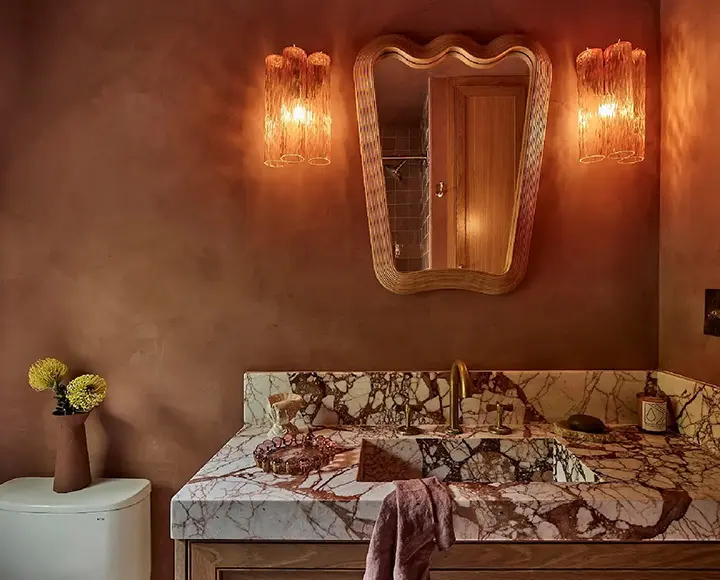
Your design of the Via La Selva bathroom feels like a departure from traditional minimalism. What was your starting point for the space? I wanted it to feel soothing and spa-like, but also have tension between masculine and feminine details. I needed it to be a retreat for me visually, so I wanted the tones to be muted and relaxed. I hate when design feels simple and boring, so the key here was making sure to have texture and movement. The travertine provides beautiful striation, and the Murano glass chandelier has the most gorgeous hand-blown glass details that add depth and softness.
In that space, how did you use tone and material to create warmth without relying on traditional “statement” design? I use living finishes to add warmth and patina to add depth. I also will use muted tones if I am going for a calming environment, but there needs to be texture and movement so that it doesn’t feel flat. I love to add small, discerning pops of color for interest, which you see in the pink chandelier. All of these little details make a huge difference in the end.
 What’s a color combination that feels very “now” without being trendy? I love a French blue or a soft, dusty grey-blue paired with chocolate. It just feels rich, grounded, and effortlessly timeless. It’s one of those combinations that’s hard to tie to a specific moment because it never really goes in or out of style. It doesn’t feel “trendy” to me, just consistently beautiful and well-balanced.
Wallpaper, especially bolder, more expressive designs, seems to be making a comeback. How are you seeing it show up in interiors right now? I am seeing people embrace wallpaper in main spaces again because for a while it felt too bold to invest in such a statement in a main space. I’m loving the commitment to a layered space. I am doing quite a few wallpapered spaces in my new home, and I am so excited for the warmth and charm they will immediately add to the house.
What’s one lighting choice people underestimate in design? How key lighting is to making or breaking the vibe of a home. If you don’t maximize the lighting locations and ways to incorporate moody little moments, you’re missing out. I want my house to be a warm hug from the world, and I’m not going to get that with overhead lighting.
 What’s one design look that instantly dates a space right now? Reeded or fluted wood vanities feel very 2019 modern and feel a little basic to me. That and Taj Mahal, eeeek!
What does “good design” feel like right now, versus even five years ago? Good design is thoughtful design, and you can tell when things were considered. The small little details that add up to one very curated and effortless space are key. I also want to see you in your home. It doesn’t need to feel fancy or expensive, but show me who you are. Do you collect things? Show me. Do you love architecture? Prove it.
I should learn about what you love from being in your space, and if I can find out more about you and feel like there is a cohesive story, well, that feels like good design to me. The bottom line is it’s not rinse-and-repeat, basic, Pinterest-land design. It’s doing things differently because you have a point of view. Good design is having a point of view and owning your own style. Don’t just copy other people’s spaces.
To learn more about Kim Lapin and her work, visit her website https://www.kimlapininteriors.com/