

Skin changes with age, but the most important shifts aren’t always the ones we can see. After 40, cumulative sun exposure, changes in collagen and elasticity, and hormonal fluctuations can alter everything from texture to how well skin retains moisture. So what deserves a place in our routines, and which innovations are actually worth the investment?
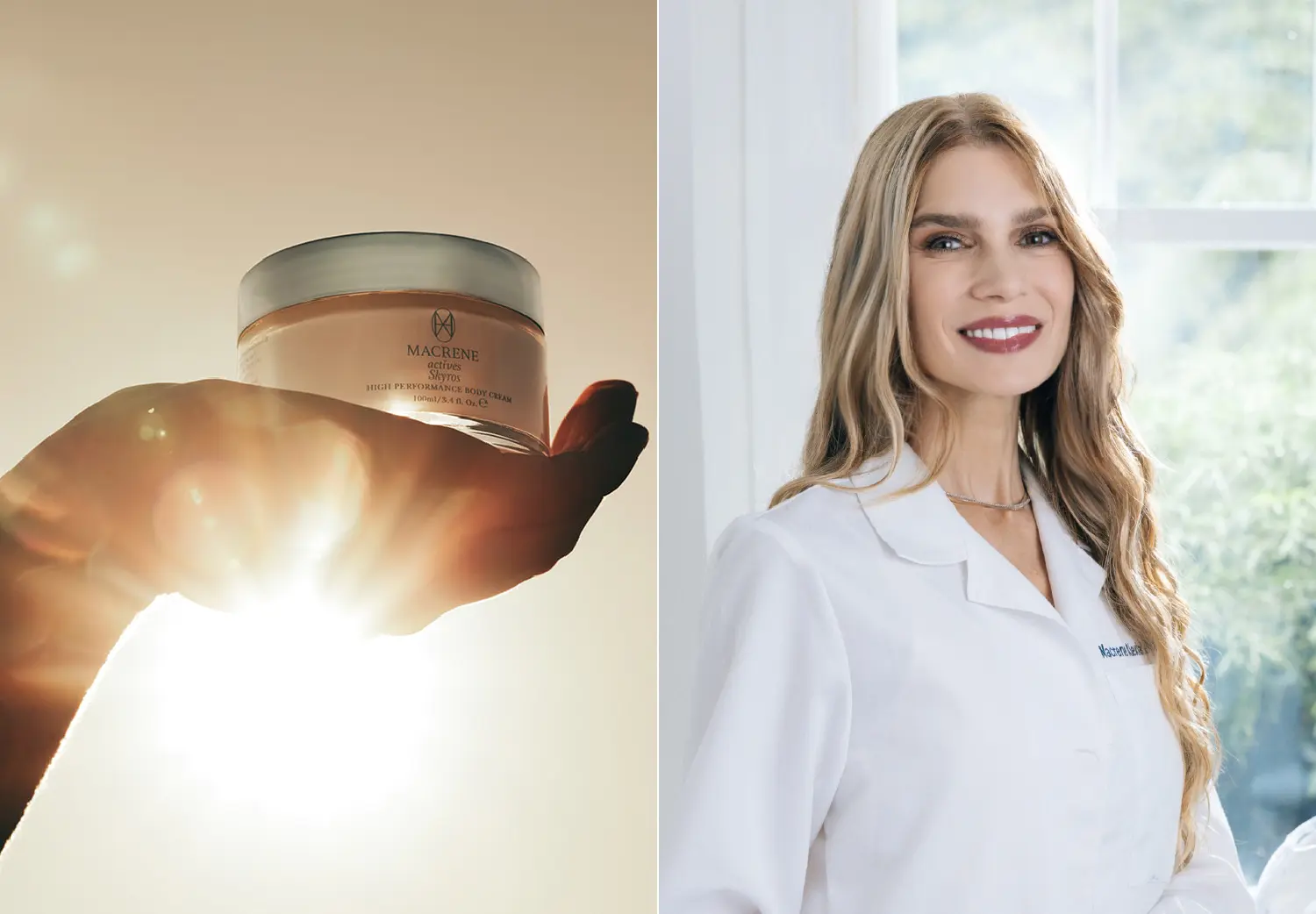
We asked Dr. Macrene Alexiades, a Harvard-trained dermatologist and molecular genetics researcher, to break down the science. Her work spans clinical dermatology, aesthetic treatments, and the development of DR. MACRENE actives, a skincare line built around her patented MA37® technology, which brings together 37 classes of active ingredients in multifunctional formulations. Ahead, she shares what she’s learned from decades of research, the products she uses herself, and her approach to caring for skin after 40.
In conversation with Dr. Macrene

Your background spans dermatology, molecular genetics, and clinical research, with an extensive academic background at Harvard. What initially inspired your interest in skin aging, and how have your decades of research and clinical experience shaped your philosophy on skincare?
My interest began long before medicine. I grew up studying insects and plants from the age of three, and I learned farming on my family’s land in Greece, where medicinal botanicals have been cultivated for thousands of years. I spent years researching plant photoregulation, how plants sense and defend against light, before turning to medicine. That question of how a living organism protects itself from the sun carried directly into my work on skin.
At Harvard I earned my BA, MD and a PhD in molecular genetics, and I went on to become double board-certified in dermatology in the US and EU. My clinical career has centered on the science of aging skin: I developed the Alexiades Classification Scale for skin aging and the Alexiades Rhytid and Laxity Grading Scale, which are used to measure wrinkles and laxity in clinical trials. I edited the textbooks Cosmetic Dermatologic Surgery and Photodynamic Therapy, and I have spent more than two decades pioneering radiofrequency, injectables, photodynamic therapy, and recently application of PRP and PRF for skin rejuvenation.
All of that shaped one conviction: skin aging is not a single problem, so it cannot be addressed with a single ingredient. It is hundreds of biological processes happening at once. My philosophy is to address all of them simultaneously, with the highest concentrations and diversity of clinically meaningful plant-derived actives, in formulas clean enough to use every day for life.
We tend to talk about turning 40 as though our skin suddenly changes overnight. What’s actually happening beneath the surface during this decade, particularly with collagen, cellular repair, hormonal shifts, and inflammation? Which of these changes do you believe conventional skincare tends to overlook?
Nothing happens overnight, however I call the sudden cliffs observed at the ages of 40 and 60 “punctuated aging.” Your 40s are when decades of change accumulate and may suddenly become visible. Collagen production has been declining by roughly one percent a year since your mid-20s, and elastin fibers have been fragmenting under cumulative sun exposure and genetic degradation. By 40, that deficit shows up as fine lines, crepiness, and a softening jawline.
Cell turnover slows, so skin looks duller and holds pigment longer. The skin’s own capacity to correct UV-induced DNA damage declines, so sun damage accumulates rather than resolves. Barrier lipids diminish, which is why many women notice their skin is suddenly drier and more reactive. Then perimenopause arrives: as estrogen falls, collagen loss accelerates sharply, with up to 30 percent lost in the first five years after menopause. Beneath the skin, facial fat pads and bone also lose volume, which is why laxity and hollowing appear together.
What conventional skincare overlooks most is chronic low-grade inflammation, what we call inflammaging, and cumulative DNA damage. Most routines focus on one visible symptom, a line or a spot, without addressing the oxidative and inflammatory processes that drive all of them. That is why I build antioxidant, anti-inflammatory, and DNA-protective actives into every MACRENE actives formula rather than treating them as optional extras.
Your patented MA37 technology incorporates 37 classes of active ingredients designed to address multiple aspects of skin aging. What makes this formulation approach different from layering individual serums, and how do ingredient stability, concentration, and delivery influence the results? What has your clinical research demonstrated about its effectiveness?
When you layer five or six separate serums, each one comes in its own vehicle, at its own pH, with its own preservatives and emulsifiers. Those vehicles accumulate preservatives beyond maximal allowable levels and compete with each other for actives penetration. In layering products, preservatives accumulate, actives often destabilize each other, some cancel out, and each additional layer dilutes the one beneath it. You also multiply the potential for irritation while reducing the concentration of each active that actually reaches the skin.
MA37® takes the opposite approach. I spent years in the lab engineering a single formula in which 37 classes of actives, including peptides, DNA repair, multiple forms of hyaluronic acid, antioxidants, plant polyphenols and sterols, brighteners, and calming botanicals, are liposomally encapsulated, compatible, stable, and present at meaningful concentrations together. Lipoencapsulation protects them from degradation and allows them to be delivered into the skin over time rather than oxidizing on the surface. Some of the most important ingredients, such as copper lysinate/prolinate and Micrococcus lysate, plankton exosomes, and Arabidopsis DNA repair are potent and notoriously difficult to stabilize, which is precisely why you rarely see them in skincare. Packaging matters too: our formulas are housed in glass to protect their integrity, and prevent bisphenol contamination as well as to protect our environment.
The original formula was the subject of my patent. In a clinical study of 31 women aged 35 to 64 using the cream twice daily for eight weeks, crow’s feet fine lines and wrinkles were significantly improved at four, six, and eight weeks using clinical trial level rigor. Today’s formulas have evolved to more than 50 actives built on that same patented MA37® foundation.

What does your own skincare routine look like today? We’d love to know your morning and evening essentials, the specific products you use, and whether there are any daily supplements you recommend for supporting skin health and healthy aging.
My routine is deliberately simple, because every product does a great deal of work.
Morning and Evening: I cleanse with the High Performance Cleanser, then apply the High Performance Face Cream to damp skin, followed by the High Performance Face Serum and Lip Filler. I use the High Performance Eye Cream around the eyes to be camera ready and extend the Neck and Décolletage Treatment from my jawline down to my chest. I finish with my Tinted Moisturiser which delivers another 45 actives. Soon enough my mineral SPF 50 with skincare ingredients (healthy enough to sleep in) will be a part of my regimen every single day, without exception.
A couple times a week I add the High Performance Eye Mask before events.
For supplements, I recommend omega-3 fatty acids for barrier and anti-inflammatory support, vitamin D if levels are low, and an oral antioxidant such as Polypodium leucotomos for additional photoprotection alongside sunscreen. Most importantly, I recommend a diet rich in colorful plants, because the same polyphenols I use topically work from within.
Retinol, vitamin C, peptides, growth factors, and exfoliating acids are often marketed as essentials for aging skin. Which are truly worth incorporating after 40, and how should we layer them for maximum effectiveness? Are there certain ingredients best used in the morning versus evening, or combinations we should avoid?
After 40, the essentials are antioxidants, peptides, and DNA repair, all accompanied by the last step of daily sunscreen. Vitamin C and other antioxidants included in the Face Cream and Serum work alongside SPF to neutralize UV and pollution-induced free radicals. If you use retinoids, they belong at night, because they degrade in sunlight and increase sun sensitivity. Peptides and hyaluronic acid are well tolerated and can be used morning and evening. Resveratrol and superoxide dismutase do the heavy lifting in keeping skin clear of free radical damage.
Exfoliating acids are worthwhile in moderation. After 40 the barrier is more fragile, so I recommend gentle polyhydroxy acids such as gluconolactone, or occasional glycolic or lactic acid, rather than aggressive daily exfoliation.
Combinations to avoid: do not use a retinoid and a strong exfoliating acid on the same night, and keep benzoyl peroxide away from your retinoid. Pure L-ascorbic acid and copper peptides are best separated as well. This is exactly the problem MA37® was designed to solve. Rather than asking women to become their own chemists, the compatibility work has already been done inside the formula.

Your High Performance Face Cream is one of your signature formulations. What makes it different from a conventional moisturizer, and which ingredients are doing the most important work when it comes to firmness, texture, and visible signs of aging?
A conventional moisturizer hydrates and seals. The High Performance Face Cream is a complete active treatment in a single jar, with the full patented MA37® complex at its core, while concurrently delivering long lasting hydration and restoring the skin barrier and microbiome.
For firmness, copper lysinate/prolinate, a rare copper peptide bound to lysine and proline, the amino acid building blocks of collagen, helps skin look firmer and more resilient. Red and blue algae, plankton, and mushroom extract support a visibly smoother, plumper texture. For lines and wrinkles, resveratrol and multiple forms of hyaluronic acid visibly smooth and plump. For tone, glucosamine, ergothioneine, and amino acids target the look of brown blotches, while bisabolol, coffee, yerba mate, and feverfew calm the appearance of redness. Micrococcus lysate, plankton, and Arabidopsis extracts, along with vitamins C and E and edelweiss, help defend against visible environmental stress. Squalane, sunflower extract, plant cholesterol, and phosphatidylcholine support a healthy-looking barrier.
It is also formulated without silicones, petrolatum, mineral oil, or fragrance, and many of its botanicals are grown organically on my farm in the Hudson Valley.
Your High Performance Eye Cream was tested on women and men ages 37 to 68, with particularly strong feedback on puffiness, firmness, and dark circles. What makes the eye area so challenging to treat, and which ingredients in your formulation are responsible for addressing these concerns?
The eyelid skin is the thinnest on the body, roughly half a millimeter. It has very few oil glands, it moves thousands of times a day, and the blood vessels beneath it show through readily. Dark circles can be vascular, pigmentary, structural, or all three, and puffiness reflects fluid that accumulates overnight in the loose tissue beneath the eye. This skin also cannot tolerate the concentrations used elsewhere on the face, so every active must be calibrated for it.
In the High Performance Eye Cream, palmitoyl hexapeptide-12 and hydrolyzed hyaluronic acid visibly smooth fine lines and help the area look firmer and plumper. Coffea robusta seed extract, caffeine, and yerba mate target the look of puffiness and the bluish cast of dark circles. A complex of amino acids, including arginine, aspartic acid, and alanine, together with gluconolactone, brightens the look of the under-eye area. Rosemary, rice bran, and sunflower provide antioxidant protection, while squalane, jojoba esters, olive-derived lipids, and bisabolol keep this delicate skin comfortable and hydrated. In our consumer study, 100 percent reported that their skin felt smoother and tighter, 98 percent reported brighter-looking dark circles, and 98 percent reported less puffiness.
The neck and décolletage are often neglected until visible signs of aging become more pronounced. What makes your NECK AND DÉCOLLETAGE TREATMENT different from a regular face cream, and what have your clinical studies revealed about its effectiveness in improving firmness, texture, and wrinkles?
The neck and chest are biologically different from the face. The skin is thinner, with far fewer oil glands, so it produces less of its own lipid. It is in constant motion, and the décolletage has typically received decades of sun with a fraction of the protection we give our faces. The result is crepiness, loss of elasticity, and brown spots that a face cream was never designed to address.
I built the Neck and Décolletage Treatment around that biology. Dipalmitoyl hydroxyproline and red marine algae target the look of elasticity and firmness. Stabilized, oil-soluble vitamin C (tetrahexyldecyl ascorbate) works with resveratrol and acetyl glucosamine to visibly brighten brown spots and even tone. Silver ear mushroom and hydrolyzed hyaluronic acid deliver sustained hydration and a visibly plumper texture. Citrulline, watermelon extract, and caffeine help the area look refreshed, while a full amino acid complex, olive-derived lipids, jojoba esters, and squalane provide the richness this skin cannot produce on its own. In clinical testing, it visibly improved the look of crepiness, firmness, skin tone, and texture. It is versatile enough to use on any area showing sun damage or laxity.

If someone is new to DR. MACRENE actives and wants to see a meaningful improvement in their skin without overhauling their entire routine, which two or three products would you start them with? What results should they look for over the first few months?
I would start with the High Performance Face Cream, the High Performance Face Serum, and the High Performance Eye Cream. Apply the Face Cream to clean, damp skin, follow with the Serum to seal in the actives, and use the Eye Cream around the orbital bone, morning and evening
Immediately, skin looks and feels more hydrated, smoother, and more luminous. Within two to four weeks, texture looks more refined, redness and dullness look calmer, and the eye area looks less puffy and more rested. By eight to twelve weeks, which is the timeline over which skin visibly renews itself, you should see the most meaningful changes: fine lines and wrinkles look softer, skin looks firmer, and tone looks more even. Consistency is what produces those results, so the routine is designed to be simple enough to follow every day.
Pro tip: once you receive your jar or bottle, place in the refrigerator to extend the durability and peak power of your actives.