
Carly Kremer has spent years making the case that bees belong in the wellness conversation. When we last caught up with the Beekeeper’s Naturals founder for our Living Well series, she talked propolis, purpose, motherhood and the surprising lessons the hive has taught her about building a company. More recently, as we explored wellness’s growing pollinator problem, Beekeeper’s Naturals became part of a bigger conversation about the relationship between our own wellbeing and the natural systems we depend on.
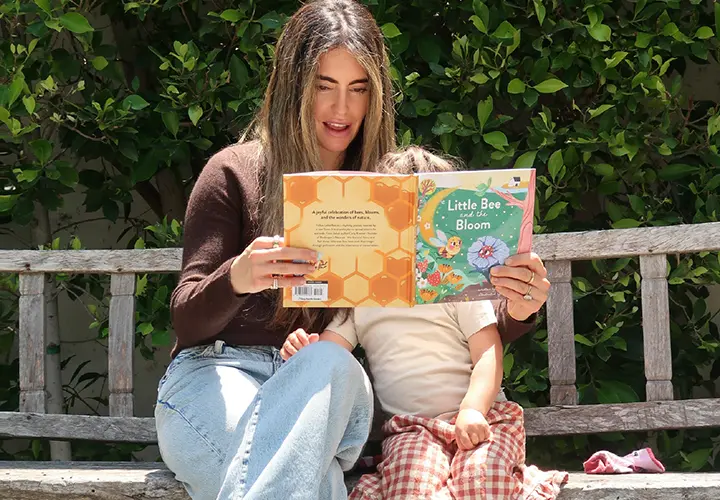
Now, Kremer is bringing that conversation to a much younger audience with her debut children’s book, Little Bee and the Bloom. Inspired in part by motherhood, the book introduces kids to bees, pollination and our connection to nature through a story designed to inspire curiosity rather than fear. We caught up with Kremer about raising a daughter who counts bees in the garden, why she believes kids should fall in love with nature before they learn to worry about it, and the bigger message she hopes families take away from the book.
In Conversation with Carly Kremer
You’ve spent years building a business around bees, but motherhood has given you a very different lens on them. What has changed most in the way you think about nature now that you’re responsible for introducing it to a child?
I’d spent a lot of time thinking about how to help adults care about bees and the environment more broadly. Before becoming a mom and writing this book, I hadn’t thought a lot about how to get kids to care. Funnily enough, though, I don’t think they’re that different. Stories can move us from a very early age. Research shows that when kids are introduced to nature picture books, they’re more likely to be aware of their environmental impact.
Beyond what the research says, I see it firsthand with my daughter. Before reading the book, she had a familiarity with bees because of the products she uses and hearing me talk about them. But after reading the book, now she, like, really cares about bees. The other day I found her singing to a bee she found in the backyard.

You’ve created a pollinator garden with your daughter and talked about letting her take part in planting it. What have you noticed about the difference between teaching kids about nature and actually giving them a relationship with it?
I’ve found that the natural world fascinates her. Just going out in the garden and exploring–you see so much activity. So much life. There’s so much to do. We go out there every morning and check on the garden. We count how many bees we can find. Kids have a natural curiosity, and if we intentionally foster it around nature, they seem to understand the value of it really quickly. Because ultimately, kids are a reflection of our own values, right? As adults we’ve been taught to ignore the natural world so much that we forget that it’s ingrained in all of us at birth to be fascinated with it. Just evolutionarily, that’s true. Our ancestors needed to be so aware of nature just to survive in it.
There’s a place for learning with pen and paper, of course, but it doesn’t replace going out there every day and seeing it and touching it. The teaching opportunities arise so organically when we’re out there.
There’s a lot of pressure on parents now to raise environmentally conscious kids. What do you think is actually worth teaching early, and what can wait until they’re old enough to understand the bigger picture?
I’m not an expert on this subject, of course. I’m just a mom. But my philosophy as a mom is to first teach my daughter about the joy and love that can be found in nature. The anxiety can come later. Just because we’re all anxious about the state of the world doesn’t mean they need to be. I’d much rather teach her to plant a garden or to protect a creature than I would to teach her to turn off the tap water.
In my view, the best way to raise environmentally conscious kids is to get them to fall in love with nature. Let them play in the dirt, show them where their food comes from – their desire to protect our planet will follow.
You’ve spent so much of your career talking about bees through wellness and science. When did you first start thinking about telling that story through a children’s book?
When I started reading to my daughter and saw how much impact a good book can have on a child. I thought, ‘if I care about this subject, this is one of the biggest impact projects I could do.’
Who did you picture reading Little Bee and the Bloom when you were writing it, and what did you want that first reading experience to feel like?
I pictured parents reading to their kids on the floor of their bedroom before bedtime. That’s how my daughter and I like to read. It’s some of the most sacred and special time we get to spend together. It’s an honor to get to play a small part in that for other parents and kids.
You’ve spent years translating bee science and wellness research for adults. What was hardest about communicating that science accurately to children without oversimplifying it?
Honestly? The rhyming! It was tough enough to explain the process of pollination in vocabulary that young kids could understand, but to have to rhyme too? That took a lot of drafts.
Another tough thing was just visualizing it in pictures. The brilliant Katie Hunt did the lion’s share of that work. The way she found to visualize the process of pollination is, in my opinion, one of the most important spreads in the book.

The book gives families practical ways to help pollinators. What are the actions that actually make the biggest difference, and which commonly suggested ones are less useful than people think?
Growing a more wild, pesticide-free yard is a big one. Research backs that up. Even if you only have a terrace or a small balcony, plant native plants for bees (and other pollinators) to visit.
One thing I hear a lot is ‘buy local honey.’ Honey bees are actually only a small fraction of the bee species in the world. Many bees don’t make honey or live in a hive. When we say ‘save the bees’ we are talking about so many more species than just the ones that make honey.
For anyone who wants to learn more, I worked with the bee lab at UC Davis to develop a toolkit for saving the bees.
For parents who want their kids to feel more connected to nature, what are a few simple things you recommend starting at home?
Get out into nature! The more natural the better. But even if it’s a park–there’s so much you can find and love in your local park. And if you can’t find time to get to a park, bring nature into your home. Get plants. Teach them to care for the plants. It’s incredible the emotional connection a child can develop with a plant. It’s really cool to see.
Are there any rituals around food, time outside, sleep or immunity that have become non-negotiable for your family?
We visit our backyard pollinator garden every morning. And we read together every night before bed to wind down and get into a kind of meditative state. We try to take hikes together as a family as much as possible and we always stop to look at insects, animals or notice beautiful flowers. I wish that were more of a routine than it is right now.
Do you see Little Bee and the Bloom as a one-off creative project, or does it signal a broader direction for how you want to talk about bees beyond wellness products?
I had so much fun doing it. For me, building a company is a creative outlet. The book was another kind of creative outlet. We’ll see what comes next. But whatever it is, it will definitely be a product of creativity and collaboration.
If there’s one idea you hope a parent and child continue talking about after they close the book, what is it?
That no matter how small you are, with a little hard work and love, you can have a big impact on the world.