
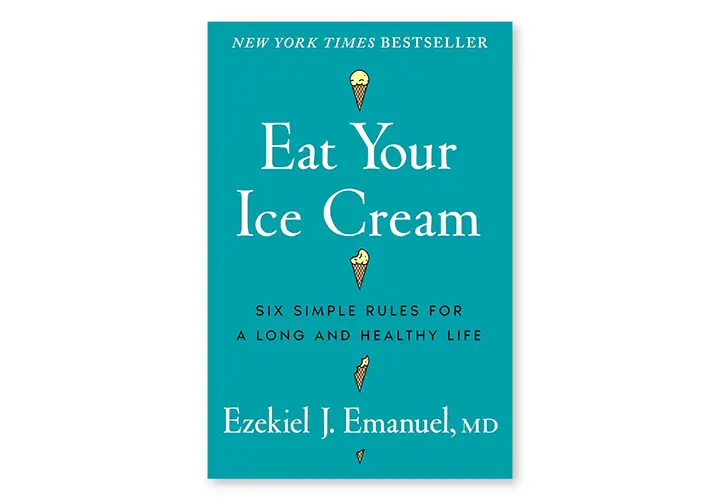
Do we really need another supplement, morning routine, wearable, or longevity hack? In Eat Your Ice Cream, physician Ezekiel J. Emanuel makes a pretty convincing case that we may be overcomplicating wellness.
Wellness can start to feel like a full time job. There is always something new to track, stop eating, start taking, wake up earlier for, or somehow fit into a routine that was already pretty full to begin with.
That is where Eat Your Ice Cream: Six Simple Rules for a Long and Healthy Life gets interesting. Emanuel’s argument is not that we should care less about our health. It is that we may be making it much more complicated than it needs to be. Across everything from food and movement to sleep, brain health, and relationships, he keeps coming back to the habits that are actually realistic enough to keep doing for years.
5 Things We Learned
+ Wellness should not become another job
There is a point where trying to be healthy can start to feel weirdly exhausting. You are tracking your sleep, your steps, your protein, your supplements, your recovery, and suddenly the thing that was supposed to make you feel better is giving you another list of things to worry about.
Emanuel keeps bringing the conversation back to the basics. Eat reasonably well, move your body, sleep enough, stay mentally engaged, and maintain strong relationships. None of that sounds especially groundbreaking, but that is kind of the point.
The reminder here is simple. Before adding another wellness habit, it may be worth asking whether the fundamentals are already in place. If not, that is probably where the biggest return is.
+ Seeing your friends counts
This might be one of the most reassuring parts of the book because it reframes something we usually think of as extra.
We are used to thinking about health in terms of food and exercise, but Emanuel puts real weight on social connection too. Strong relationships, regular interaction, and feeling connected to other people all play a role in long term health.
So yes, dinner with friends matters. Calling someone instead of sending another text matters. Making the effort to actually see people you care about matters.
A lot of us treat social plans like the thing we squeeze in after work, workouts, errands, and everything else gets done. Maybe they deserve to move a little higher up the list.
+ Your brain wants something new
Doing the same puzzle every morning is fine, but Emanuel makes a good case for giving your brain something unfamiliar to work with too.
His own approach is pretty fun. Over the years he has taken on new things like chocolate making, beekeeping, and ballroom dancing. The point is not to become amazing at every hobby. It is to keep putting yourself in situations where you have to learn, concentrate, and be a beginner again.
That could mean taking a language class, learning to cook something totally outside your comfort zone, trying pottery, picking up an instrument, or finally learning mahjong because everyone else somehow already knows how to play.
It is good for the brain, but it also makes life more interesting, which feels like a win either way.
+ More exercise is not always better
There is a funny thing that happens with exercise. Once something is good for us, we start assuming more must be even better.
Ten thousand steps turns into fifteen thousand. Three workouts turns into six. Missing a class suddenly feels like you did something wrong.
Emanuel takes a much more balanced approach. He looks at movement through a few basic buckets: cardiovascular exercise, strength, balance, and flexibility. The bigger idea is that being well rounded matters more than endlessly trying to do more.
You probably do not need to turn every workout into a personal record. You just need to move regularly, stay strong, and keep doing the mobility work we all remember we need right around the time something starts hurting.
+ Eat the ice cream
This is the part everyone remembers, and yes, Emanuel actually means it.
His point is not that nutrition does not matter. It is that a healthy way of eating still needs to leave room for pleasure. If your version of wellness depends on saying no to everything you enjoy, chances are it is going to be pretty hard to stick with.
The larger food advice in the book is not especially dramatic. Eat more fruits, vegetables, nuts, fiber rich foods, fermented foods, and minimally processed foods. Cut back where it makes sense. Then stop expecting every meal to be perfect.
One dinner, dessert, vacation, or skipped workout is not what determines your health. What you do most of the time matters much more.
And eating something you love with people you love sounds a lot more like living well than sitting at dinner worrying about whether you should have ordered it.
What we are taking from it
For a book about longevity, Eat Your Ice Cream is surprisingly good at reminding you not to spend your whole life obsessing about longevity.
That may be the part we liked most. Health matters, but the goal is not to create the most optimized routine possible. It is to feel well enough to actually enjoy your life.
Move your body. Get enough sleep. Keep learning things. Eat food that makes you feel good. Make time for people you care about. And when you really want the ice cream, have the ice cream.