
Some of the links in this story are affiliate links, which means we may earn a commission if you choose to purchase—helping us continue to share mindful, inspiring content.
Vitamin C might be one of the most talked about ingredients in skincare, but it is also one of the most misunderstood. Between percentage debates, oxidation fears, and layering confusion, the science often gets buried under the hype.
For chemist and founder Marie Veronique Nadeau, the conversation starts with biology. Vitamin C is essential to collagen production, cellular repair, and long term skin resilience. No Vitamin C equals no collagen. The real question is not whether you should use it, but which form your skin can actually tolerate and benefit from.
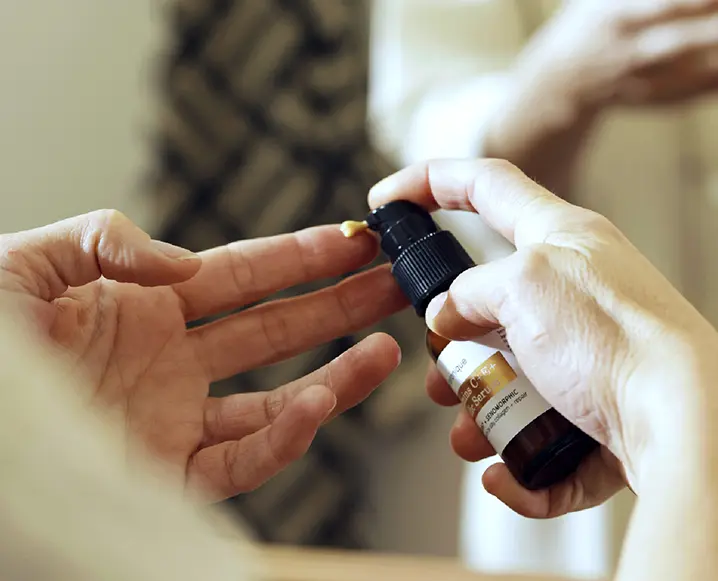
Through her brand Marie Veronique, she has developed two distinct approaches to topical Vitamin C: the antioxidant driven Vitamins C+E+Ferulic Serum, and the gentler, derivative based C Therapy Serum designed for more sensitive or reactive skin types. Both reflect her longevity first philosophy and her belief in smart formulation over trend chasing.
We sat down with Marie to decode what Vitamin C is really doing in your skin, how to choose the right version, what to avoid, and why pairing it strategically with retinol may be one of the most powerful moves you can make for long term skin health.
You can read our previous Living Well Interview with Marie Veronique Nadeau here.
In Conversation with Marie Marie Veronique Nadeau

How should someone incorporate Vitamin C into their morning and/or evening routine? Ascorbic acid is still very much the gold standard in skin care. For most people a serum containing ascorbic acid stabilized in an anhydrous system with a pH of 4 to 4.5 will be their first choice, especially one that is further stabilized with Vitamin E and ferulic acid. It can be used in the morning under sunscreen to obtain additional anti-oxidant protection. It can be used at night to aid in regenerative mechanisms such as collagen production. Ascorbic acid hydroxylates proline, and is one of the first steps in collagen biosynthesis- no Vitamin C, no collagen.
People who have trouble tolerating a low pH, i.e., have sensitive or sensitized skin or inflammatory conditions such as rosacea, should be looking for a Vitamin C derivative in their serum. No one should try to apply Vitamin C directly onto their skin—this can be very damaging.
Can you use Vitamin C with retinol? Yes, absolutely, and anyone interested in skin longevity will want to. You can use them together (layered) or split them into morning and evening usage. Use vitamin C in the daytime for its antioxidant properties and retinol at night, when you get the best benefit from its signaling properties that send instructions to the fibroblasts to make more collagen. You get fantastic synergy from using both—Vitamin C provides a necessary step in collagen production, while retinol converts to retinoic acid in the cell, where it binds to receptors that act as chemical messengers that inform processes such as upregulation of collagen production and cell turnover and downregulation of melanin production (for brighter skin).

What should people look for (and avoid) when selecting a Vitamin C product? First, avoid AA (ascorbic acid) powders which can give you an acid burn.
People looking for protective and longevity benefits should look for a serum with Vitamin C as ascorbic acid in combination with helper antioxidants like Vitamin E and ferulic acid.
For people with sensitive or sensitized skin, look for a Vitamin C derivative. You can refine your search to look for the derivative that conforms to your special needs. For example, people looking for skin brightening effects should search out ingredients like glyceryl ascorbate and tetrahexyldecyl ascorbate. People with acne issues should look for SAP (sodium ascorbyl phosphate) for its ability to reduce sebum oxidation in congested pores, a major cause of acne. And of course sensitive, challenged skin that is in that age group where collagen building is important should seek out THA (tetrahexyldecyl ascorbate) and MAP (magnesium ascorbyl phosphate); both have good performance records for penetrating to the fibroblast to hydroxylate proline. The cell releases hydroxyproline, a necessary component of collagen, and the hard and fast rule is: no Vitamin C = no collagen!
How does Vitamin C interact with other active ingredients like retinoids, AHAs/BHAs, and peptides?
- Vitamin C + retinol has significant synergistic interactions, with signaling from retinol plus hydroxyproline from Vitamin C providing benefits across age-delay and skin brightening platforms. In addition to boosting collagen production, the two also interact via epigenetic mechanisms to promote epidermal thickening.
- Interaction of AHAs and BHAs can increase skin sensitivity as they are acids. Vitamin C has enormous benefits and can be used every day, while an AHA for exfoliation can be used once a week, separately from Vitamin C. I recommend lactic acid for exfoliation treatments, as it has, in addition to being gentle, a great skin longevity profile—including boosting collagen production and dermal thickening. It also acts as a signaling molecule to regulate autophagy.
- Vitamin C and peptides: It’s probably best to use Vitamin C and peptides separately, because of potential pH conflicts where effects are neutralized (particularly in the case of copper peptides). Use vitamin C in the morning for antioxidant benefits and peptides at night for repair purposes.
Your brand offers Vitamins C+E+Ferulic Serum and C-Therapy Serum, at a high level, what is the core difference in purpose and performance between these two? Vitamins C+E+Ferulic Serum combines powerful antioxidants to deliver increased antioxidant protection, plus Vitamin C as ascorbic acid promotes collagen production. It is designed for people with normal skin who need protection and want the age-delay benefits of Vitamin C delivered in a way that produces maximum results.
Everybody needs Vitamin C, but not everyone can use ascorbic acid. This is why we developed C-Therapy Serum, for those people on the spectrum with Vitamin C sensitivity or other issues. Vitamin C derivatives are stable and deliver l-ascorbic acid to the skin without creating issues with sensitization. In addition, each derivative in C-Therapy Serum performs a special range of tasks. Clinical studies show that: sodium ascorbyl phosphate prevents oxidation of debris in congested pores to clear breakouts, glyceryl ascrobate moisturizes and improves barrier function, and magnesium ascorbyl phosphate and tetrahexyldecyl ascorbate impede hyperpigmentation processes and increase collagen levels. The formulation is rounded out with alpha-lipoic acid –the universal antioxidant that helps prevent damage to mitochondrial DNA.

Are there ingredients you should avoid pairing with either serum? They are designed to work with most ingredients but remember the rules—you don’t want to avoid lowering pH so be careful in combining with AHAs, BHAs, and the other rule: Protect by day and repair by night—so use antioxidants by day and retinol and other signal peptides for repair by night.
How can you tell if your Vitamin C serum has oxidized and is no longer effective? The color should remain the same as when you first use it, if it starts turning darker that is a sign that it might be oxidizing.
How does your formula differ from other C+E+Ferulic serums on the market? We pay attention to synergy, both within the formulation, where we want to increase the antioxidant power of the serum, but within the wider context of how Vitamin C works with other protective and regenerative products, particularly sunscreen and retinol serums.
We incorporate advanced technology in a light-weight serum that can be layered with sunscreen by day to deliver antioxidant protection, or with a retinoid product at night to ensure that sufficient l-ascorbic acid is in skin tissue to respond to retinoic acid signaling to make collagen.
Vitamin C must be present to hydroxylate proline for the formation of a stable collagen triple helix. To fully optimize skin health and longevity, we recommend combining oral supplements, taken daily, with either topical Vitamins C+E+Ferulic Serum or C-Therapy Serum, also to be used daily.
Is there an emerging ingredient or new research direction in antioxidant science that you’re excited about in skincare? Yes, there are new studies indicating that Vitamin C plays a role in skin regeneration via epidermal thickening—which adds greatly to its longevity profile, as it addresses the crepey skin issue that is of special concern for mature skin. Acting through the epigenetic mechanism called DNA demethylation, Vitamin C drives TET enzymes to reactivate genes that boost keratinocyte proliferation and increase epidermal thickness.
Synergy is the other exciting news; use of retinol and Vitamin C together enhances the skin thickening process—retinol acts as a signaling molecule to upregulate and increase TET enzymes within the cell, while Vitamin C acts as the cofactor to recharge the enzymes. Using the two vitamins together influences the epigenome and promotes skin longevity.