
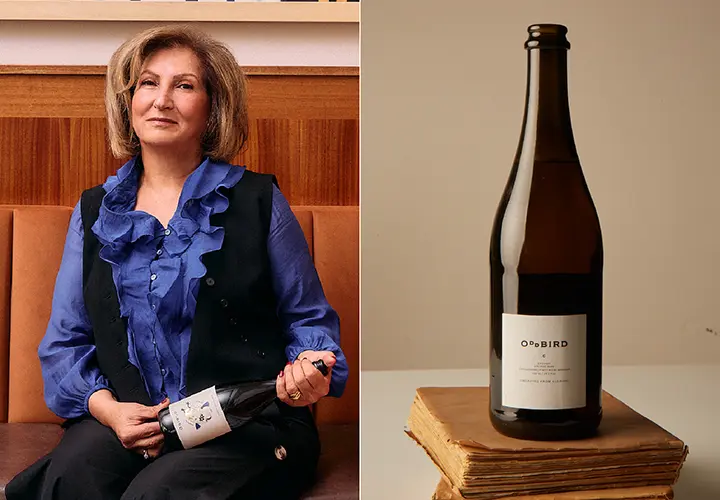
For more than two decades, Moa Gürbüzer worked as a family therapist and social worker in Sweden, closely witnessing the ways alcohol quietly shapes families, relationships, and everyday life. Over time, she began to see the issue not just as individual, but something much larger, rooted in culture itself.
That perspective eventually led her to create Oddbird, a dealcoholized wine brand built to challenge long held norms around drinking and offer a more intentional way to celebrate. With no background in business or winemaking, she built the company from the ground up into a globally recognized brand known for its craftsmanship, research, and thoughtful approach to wine.
In this Living Well, Moa shares what she’s learned from building Oddbird, how her background continues to shape the way she leads, and why she believes celebration is less about alcohol, and more about presence.
Living well with Moa Gürbüzer
You founded Oddbird after more than two decades working as a therapist and social worker. What experiences from that chapter of your life ultimately led you to create the brand? During my years in therapy, I witnessed the ripple effects of alcohol, not just on the person drinking, but on families, children, and communities. I often saw the same silent patterns, children tiptoeing, partners covering up, families pretending everything was fine, while alcohol quietly shaped everything around them.
I realized I could spend my career helping people rebuild after the damage, or I could try to stop it before it happened. Oddbird became my attempt at prevention.
Starting a wine company with no background in business or wine is such a bold move. What pushed you to finally say, “I’m doing this”? I came to the conclusion that I had to do something to offset the societal pressures when I began teaching social work at a Swedish University. I realized that my first day on the job looked exactly the same as my last, the same life stories, the same dead ends, the same problems that never changed.
Nothing was happening on a structural level. It struck me that the entire system of social services was built on placing blame on the individual, instead of working preventatively before addiction or dependency developed. When I stood there as an educator, looking at young students preparing to walk the same path, I reflected on my own work.
That’s where the seed was planted, the idea that I wanted to contribute to change on a larger scale. I believe that power lies in working preventatively and structurally. Because while support matters deeply once harm has occurred, I think we as a society have a responsibility to create a culture where fewer people end up there at all.

What were the earliest days of building the brand like? In the early days, when I shared my ambition to create high-quality wine without alcohol, most people were quick to dismiss it as impossible. I saw a problem that others weren’t willing to engage with, and made a conscious decision to pursue it regardless, learning to block out the skepticism and stay anchored in my vision.
At the same time, I needed funding to keep going. Banks turned me down, investors did not show any interest, and it felt like opportunities were slipping away one by one. Just when it seemed like I had run out of options, my hairdresser stepped in and lent me the money I needed. She believed in me at a time when very few others did.
Her support allowed me to continue from a financial perspective, but it also gave me a sense of confidence and determination that I really needed at that time. It reminded me that belief can come from the most unexpected places, and that sometimes all it takes is one person who truly sees what you’re trying to build. I will always be deeply grateful for her trust.
After working as a therapist for so many years, how has that background shaped the way you lead a company? It has shaped everything. As a therapist, you learn to really listen, to understand what’s not being said, and to meet people where they are. I try to lead in the same way, with empathy, clarity, and honesty.
It also made me very aware of how much people carry, both in their personal lives and at work. So creating a safe and respectful environment for the team has always been important to me.
Your team leads one of the world’s largest research initiatives around dealcoholized wine. What inspired you to invest so heavily in the science behind it? We actually lead the world’s largest research consortium on dealcoholized wine, working with universities, researchers, and winemakers across more than 16 countries to continuously push the boundaries of our category.
For the past 14 years, our mission has been very clear, we are here to change drinking culture, and it’s not something we can achieve without investing in research. We believe this transformation must be built on rigor, and rigor means science. For us, research is not an add-on, it’s a given. It’s something we see as essential, like part of the daily routine.

A lot of people still assume alcohol free wine can’t match the structure or complexity of traditional wine. What has your research revealed that challenges that assumption? The complexity of wine comes from the soil, terroir, nature, fermentation, and maturing. Ethanol is just a very harmful byproduct of that process. We are only removing a small piece of an intricate and natural process, and by doing so, we are keeping the complexity, flavor, and structure.
What has been the most meaningful moment for you since launching the brand? It’s really hard to pinpoint one single moment. But the most meaningful ones are when people tell us they chose our wines for important occasions in their lives, weddings, celebrating a newborn, birthdays, proposals, and moments like that.
It’s difficult to put into words how humbling it is to be part of something so personal. To be chosen as even a small part of someone’s important life moment means a lot to us.
For someone discovering Oddbird for the first time, which bottle would you recommend starting with and why? It really depends on what kind of wine you usually enjoy. We work with different regions, grape varieties, and terroirs, so each wine really has its own personality. But our Blanc de Blancs is our most popular wine worldwide, and often the one people discover us through, so it can be a natural place to begin.
Do you have a favorite wine in the Oddbird collection? Oddbird C is my favourite, largely because of what it represents. It’s a wine I’ve envisioned since the very beginning of Oddbird, and seeing it come to life has been incredibly meaningful. SHOP ODDBIRD C HERE
As the product of five years of research, growing, aging, and dealcoholizing, C is our most complex creation to date and is a first of its kind dealcoholized champagne blend. It truly represents how far we’ve come.

If you were hosting a dinner party and serving Oddbird wines throughout the evening, how would you build the lineup? The food should guide the pairing. If you’re serving fish, seafood, or lighter dishes like fresh salads, you should opt for something fresh and crisp like our Blanc de Blancs.
If your menu includes acidity, spice, umami, or more savory and salty flavors, often found in cuisines like Japanese, Vietnamese, or Korean, you should pair it with our Riesling blend Presence. It brings high acidity along with floral and mineral notes that complement those profiles well.
If you’re serving grilled white meat, grilled fish, or seasonal vegetables, our Sparkling Rosé is a natural choice, thanks to its acidity and subtle berry profile.
If you’re serving dishes with higher fat, you need wines with good acidity and structure. In that case, our Low Intervention Sparkling Orange or GSM would be most suitable.
What has surprised you most about how drinking culture is evolving today? Only a few years ago, non-alcoholic options weren’t even considered part of the industry. Now, some of the world’s best restaurants, hotels, and events are starting to include Oddbird on their menus and wine programs.
This signals a real shift in recognition and creates dignified options for consumers that choose not to drink alcohol. As more people remove alcohol from their lifestyle, consumers have demonstrated that they want quality options that don’t compromise on taste or an intentional experience.
This demand is pushing the industry to innovate and expand in exciting ways to create products that were considered impossible a decade ago. We hope to be part of a larger cultural shift that questions why alcohol has to be the default in every social situation.
And finally, what’s a small piece of advice you’d offer someone who is rethinking their relationship with alcohol? Choosing alcohol free is not about giving something up, it’s about discovering new dimensions of taste, presence, and connection.
I encourage curiosity over restriction. Savor each moment more consciously, engage fully with friends, food, and experiences, and take pride in a choice that aligns with your lifestyle and values.
Dealcoholized wine can open the door to a richer, more thoughtful, and joyful way of celebrating life. It’s not the ethanol that defines how we connect, share, or rejoice, it’s presence, intention, and joy.