
We spend a lot of time thinking about the food we eat, the skincare we use, and the supplements we take. But the one thing we consume more than almost anything else is often the one thing we question the least: water.
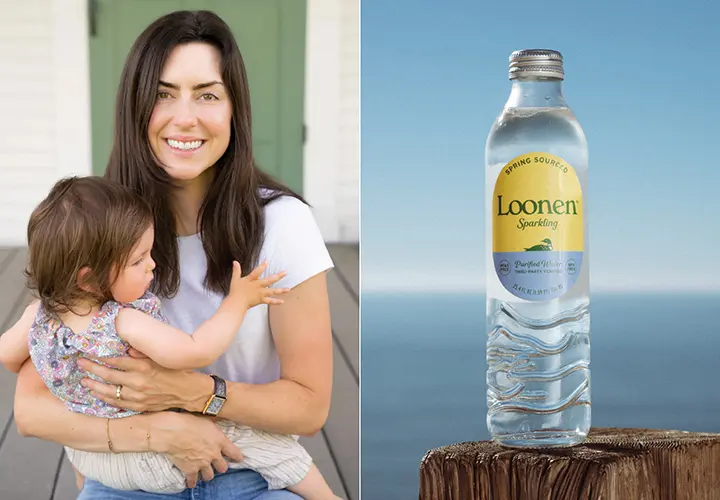
For Clara Sieg, Co Founder and CEO of Loonen, that question became deeply personal during her IVF journey and pregnancy, when she began taking a closer look at what she was putting in and on her body. The more she learned about plastics, PFAS, and water quality, the more she realized how little transparency existed around something so fundamental to our health. Drawing on years of experience investing in consumer brands, she set out to build one that would raise the standard for bottled water.
In this edition of Living Well, Clara shares the story behind Loonen, what consumers should actually look for when choosing bottled water, the simple changes she recommends to reduce everyday plastic exposure, and why living well has become less about chasing perfection and more about getting the fundamentals right.
Living Well with Clara Sieg
For those who may be discovering you and your brand for the first time, how would you describe yourself and Loonen? I’m the co founder and CEO of Loonen, a water company born from my own IVF journey and then pregnancy, when I started paying close attention to what I was putting in and on my body. I learned a lot about plastics and endocrine disruptors, and just how pervasive they are. I made swaps across our home to minimize our daily exposure, from food to beauty to cleaning, but when it came to water, I couldn’t find a bottle I trusted for my family. That’s how Loonen was born.
Our goal is to be the cleanest water you can find: spring sourced, filtered for purity, perfectly balanced minerality, and only ever bottled in glass. We test for microplastics, forever chemicals, and hundreds of trace contaminants, with results published and available via QR code from every bottle. Not just pure, but proven.

Before launching Loonen, you spent years investing in consumer brands. What was that chapter of your life like, what drew you to that work, and what finally pushed you from investor to entrepreneur? I spent close to two decades on the investing side, and honestly it’s the reason I never wanted to be a founder. I had a front row seat to how hard building something is and how many great ideas don’t make it. I loved the work though: sitting with founders, getting obsessed with their categories, watching the rare few who do it right compound over time.
The thing that finally pushed me wasn’t a strategy, it was my own life. Getting pregnant and staying pregnant was a long road that led to IVF, and along the way I went deep on plastics and endocrine disruptors and started changing habits. Water was the one category where I couldn’t find what I wanted and yet it’s the thing I consume most of. At some point it shifted from an obsession to an imperative. I went all in.
One of the most important lessons I took with me was embracing knowing what I don’t know. I know what I’m good at, and I know very well what I’m not good at, it’s a lot, so we’ve thoughtfully built a team that brings expertise across those gaps. The weak spots become our superpowers and connective tissue, and that’s a big part of why our team works so well together.
You often speak about how becoming a mother changed your perspective. In what ways has motherhood influenced the way you approach business and life? Motherhood made me determined in a way nothing else has. I’m probably 90% plastic at this point, but my daughter doesn’t have to be, and that’s a very clarifying motivation on the hard days. It’s given me more confidence to do hard things. I grew a baby! And it narrowed my world. I’m more efficient and less precious about what doesn’t matter.
When you first started researching water quality, what shocked you the most? Was there a statistic, study, or piece of information that completely changed how you viewed water? Water is foundational. You’re roughly 60% water, and a newborn is closer to 75%. It’s what we drink day in and day out, and what we mix our babies’ bottles with.
Yet nearly half of US tap water contains PFAS, more than half tests positive for lead, and there are no federal standards for microplastics in tap or bottled water. And the part most people don’t expect: bottled water is less regulated than tap.
Water should be the single most trustworthy thing we consume, and instead it’s one of the least transparent.

When people hear terms like PFAS, microplastics, and contaminants, it can feel overwhelming. What should the average person actually be paying attention to? I try to focus on what I can control and let go of the rest. I’m a big believer in 80/20.
If I had to simplify it: get a high quality water filter for home and, when selecting bottled water, opt for glass. Remember bottles that are aluminum and cardboard are all plastic lined and the supply chain of water is hot and long which creates a perfect environment for plastic leaching.
Pay close attention to source, filtration practices, and transparent testing. Favor anything that will actually show you its results instead of just claiming to be pure.
Make the easy swaps where you can, boring, set it and forget it stuff, especially for the things you repeat every single day. And don’t lose sleep over drinking plastic water on a plane. Better to do a few foundational things consistently than try to engineer every variable and burn out.
For someone who wants to reduce their exposure to plastics but doesn’t know where to start, what are the first three swaps you’d recommend? Water. Obviously I’m biased, but it’s the thing you consume more than anything else, so it’s the highest leverage swap.
Stop heating and storing food in plastic. Heat drives plastic to leach, so a hot dish or a microwave is the worst case. Move to glass containers and never microwave in plastic.
Your everyday repeats. Look at the items you touch constantly, the plastic cutting board, what you clean your house with, the non stick pans, your beauty products, and trade the ones with an easy alternative. Small, boring, repeatable beats one big dramatic overhaul.
The goal isn’t a plastic free life, that’s impossible. It’s removing the easy, high frequency exposures and not stressing about the rest.
Beyond choosing glass over plastic, what are the biggest factors that determine whether a bottled water is truly high quality? The honest answer is that quality is cumulative. It’s the whole chain, not one hero step.
A lot of the category wants you to believe purity is about geography alone, a pretty source and a picture of a waterfall. But a natural source is living and changes season to season, and in a globally connected water system, even the best springs have footnotes. Filtration helps, but no method removes everything, especially if the source is compromised. So at Loonen we follow WHO guidance, which is to not rely on just the source or just the filtration, but to do both really well: a high quality natural source, high quality filtration, and then add mineral balancing, careful transport and bottling, and comprehensive testing.
Which brings me to transparency. If a brand can’t or won’t show you third party results for things like microplastics and forever chemicals, that tells you something on its own.
How do you balance being a founder, mother, and individual without feeling pulled in too many directions? I don’t really believe in work life balance. What we aim for is work life integration, and honestly, right now it’s less balance and more survival, and I think pretending otherwise does other women a disservice. My husband runs his own company too, so we’re tag teaming constantly. We genuinely couldn’t do it without deeply involved grandparents and an incredible nanny.
My team knows my daughter. She does demos with me on weekends. If childcare runs late, she’s bopping around next to me, and that’s our culture, not a failure of it. It keeps us human and reminds everyone that there’s something bigger we’re building toward.

What qualities do you think every successful founder needs? Honestly, I’m not sure I’m the right person to answer, I’m still very much in it myself. But if I had to point to anything, it would be grit and resilience. Almost everything goes wrong at some point, so a lot of it is just continuing to show up, especially on the days it would be easier not to. I think the other piece is being able to hold the big picture and the day to day at the same time, staying close to the vision while rolling up your sleeves and chipping away at it without getting lost in the weeds.
As both an investor and founder, what are some brands you think are setting a thoughtful example for the industry right now? My north star is Levi’s. It might not seem analogous to water, but Levi’s is a heritage American brand built on quality and on making someone feel great. That’s exactly why it’s endured and stayed beloved for generations. That’s the kind of company I hope we build: stand on the quality of our product, make people feel good, and let that be the most.
What does living well mean to you today? For a long time wellness was all about optimization, tracking every metric, stacking supplements, engineering your way to health. I found it exhausting.
What living well means to me now is a quieter return to good foundations: the water you drink, the food you eat, how you move, how you sleep. Not a trend or a protocol, just a good way to live.