
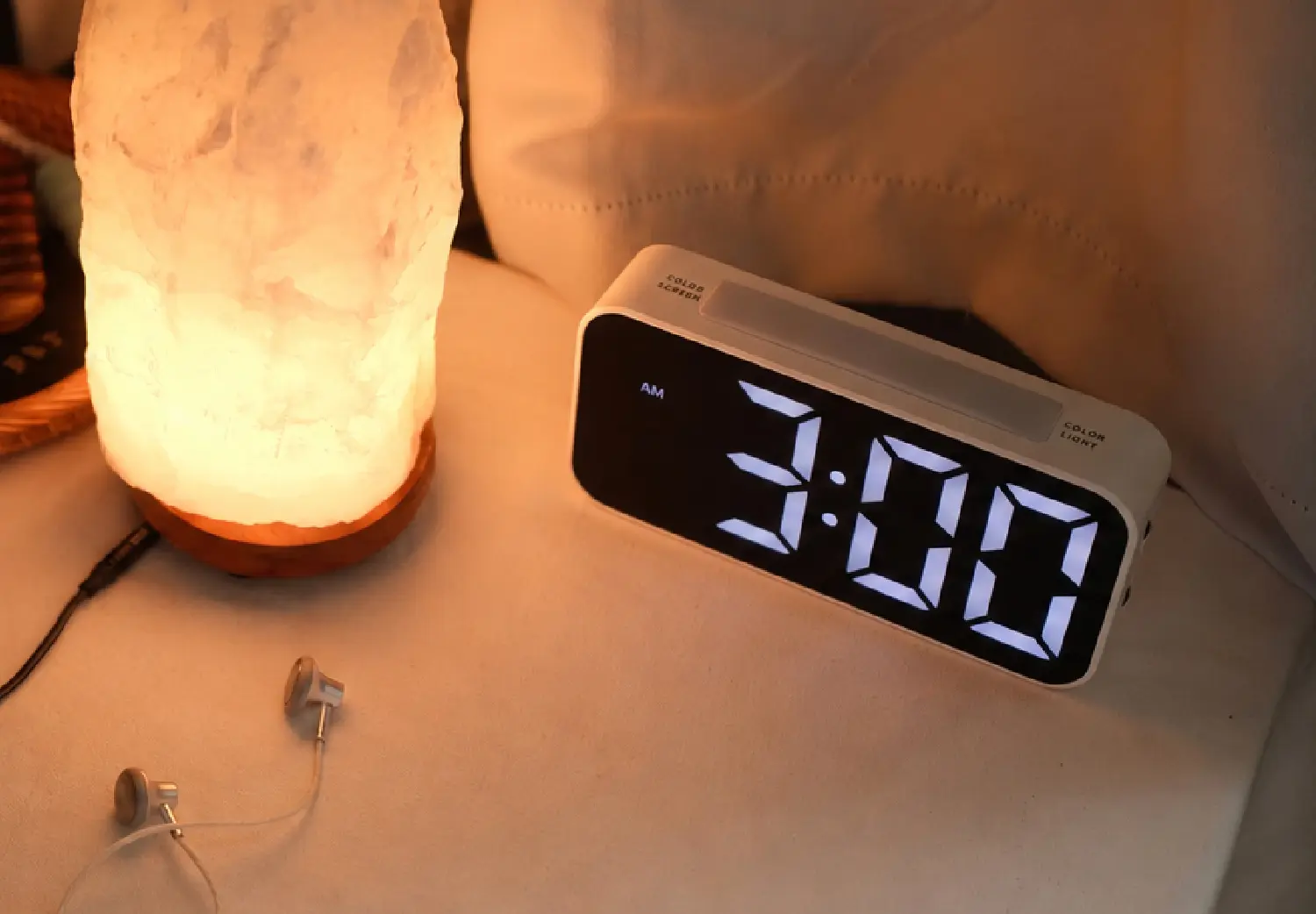
You went to bed at a perfectly reasonable hour. So why are you staring at the ceiling at 3 AM, wide awake and mentally calculating how much sleep you have left? If this sounds familiar, Traditional Chinese Medicine (TCM) offers an interesting perspective on why you might keep waking at the same time every night.
According to the traditional Chinese body clock, different times of day are associated with different organ systems and the movement of energy, or Qi, throughout the body. While waking at a particular hour isn’t a medical diagnosis, TCM practitioners use this framework alongside other observations to understand patterns of imbalance.
To explore what this ancient approach can teach us about modern sleep struggles, we turned to Pasu Harisadee, a Traditional Chinese Medicine educator at RAKxa Integrative Wellness in Thailand. From the significance of the 3 AM wake-up to at-home acupressure, calming evening rituals, and techniques for falling back asleep, she shares her perspective on what might be keeping you up and how to find your way back to more restorative rest.
From a Traditional Chinese Medicine perspective, what can it mean when someone consistently wakes up around 3 AM? Can you explain how the TCM body clock relates to sleep, including the 1–3 AM and 3–5 AM windows?
According to The Yellow Emperor’s Inner Canon (黄帝内经), one of the oldest and most important foundational texts in Traditional Chinese Medicine, living in harmony with nature is essential for health, disease prevention, and longevity. The text describes the concept that nature and humans are interconnected (天人合一), with the body’s physiological changes closely tied to the rhythms of time, climate, and the environment.

The TCM body clock, also known as the organ clock, is a 24-hour cycle that tracks the flow of vital energy, or Qi, through the body’s 12 primary organ meridians. According to TCM theory, Qi peaks in a specific organ system during a two-hour window, making that the optimal time for its associated physical and emotional functions.
Daytime represents active Yang (阳) energy, while nighttime represents restful Yin (阴) energy. Maintaining balance between these two energies and aligning them with the natural rhythms of day and night are fundamental principles of TCM.
In this framework, sleep and wakefulness are governed by the dynamic interaction between Yin and Yang, the movement of Wei Qi (Defensive Qi), and the state of the Shen (Mind or Spirit). Difficulty falling asleep, waking during the night, frequent nightmares, trouble returning to sleep, and night sweats are traditionally interpreted as possible signs of imbalance.
Between 1 AM and 3 AM: The Liver Meridian
In TCM, this period corresponds to the Liver meridian, which is associated with the Wood element. The Liver is traditionally understood to restore Blood and maintain the smooth flow of Liver Qi, both of which are considered essential for recovery and the body’s natural healing processes.
Within this framework, disrupted sleep during the Liver’s associated hours may suggest an imbalance in these functions.
Between 3 AM and 5 AM: The Lung Meridian
The hours between 3 AM and 5 AM correspond to the Lung meridian. This period marks an energetic transition as nighttime Yin begins to wane and daytime Yang gradually rises.
Associated with the Metal element, the Lungs are described in classical TCM texts as the “Imperial Umbrella” (肺为华盖), a protective canopy that shields the internal organs from external pathogens.
The Lungs are also believed to govern the dispersing and descending movement of Qi, distributing nourishment throughout the body and supporting its protective functions.
From a TCM perspective, repeatedly waking during this period may suggest a disturbance in the Lung meridian or its associated functions.
These traditional associations offer a way to interpret sleep patterns within TCM, although the time someone wakes up cannot, by itself, establish that a particular organ is unhealthy.
What are the most common daytime or evening habits you see contributing to middle-of-the-night waking, and what changes would you recommend people make to support more continuous sleep?
A modern sedentary lifestyle combined with high-stress, late-night work can create a cycle that disrupts the body’s circadian rhythm.
Sitting for prolonged periods reduces physical activity and daytime sleep drive. Meanwhile, working late into the night under stress can increase physiological arousal, while exposure to blue light from electronic screens can interfere with the body’s natural melatonin production.
Together, these factors can make it harder for the body to transition into a restful state.
In TCM, this pattern is understood as a depletion of Yin energy and an overstimulation of Yang. Staring at screens late into the evening is traditionally believed to strain the eyes and consume Liver Blood, contributing to Liver Qi Stagnation and Liver Fire.
When this excess heat agitates the Heart Shen (Mind), it can disturb sleep, particularly during the Liver and Lung hours between 1 AM and 5 AM.
Restoring balance requires establishing clear boundaries between daytime physical activity and nighttime mental rest. Regular movement during the day and a deliberate transition away from stimulating activities in the evening can help support a more consistent sleep schedule.
If someone wakes up at 3 AM and can’t fall back asleep, what should they actually do in that moment? Are there specific breathing techniques or other TCM practices you recommend?
Practice diaphragmatic breathing, a technique that encourages slower, deeper breaths and helps the body settle into a more relaxed state.
Here’s how to do it:
+ Hand placement: Place your dominant hand over your navel, an area known in TCM as the Lower Dantian, and your other hand on the center of your chest. Close your eyes and focus on the sensation of your breathing.
+ Inhale for four seconds: Breathe slowly and quietly through your nose, allowing your lower abdomen to expand while keeping your chest relatively still. In TCM, this downward expansion is believed to help the Kidneys grasp Lung Qi and anchor rising Yang energy.
+ Exhale for six to eight seconds: Breathe out softly and completely through your mouth, allowing your lower abdomen to gently contract. Imagine releasing accumulated tension, heat, and stagnant Qi from your chest.
+ Repeat for three to five minutes: Continue the breathing cycle until your breath becomes steadier and your body begins to feel more relaxed.
Are there particular teas or traditional evening rituals you recommend for supporting deeper, more continuous sleep?
A TCM-inspired evening routine focuses on calming the Shen (Mind or Spirit) and helping the body transition from the active Yang energy of the day into the restorative Yin energy of the night.
I recommend incorporating the following practices.
+ A mind-calming herbal tea
Sip a warm, caffeine-free herbal tea in the evening. In TCM, certain herbs and flowers are traditionally used to nourish Heart Yin, soothe Liver Qi, and encourage relaxation.
Some ingredients to consider include:
- Chrysanthemum: Traditionally used to clear Liver heat and support eye health. It also contains antioxidant flavonoids.
- Jujube dates: Valued in TCM for nourishing Heart Blood and calming a restless Shen.
- Goji berries: Traditionally used to tonify Liver and Kidney Blood. They also contain carotenoids with antioxidant properties.
- Rose: Used in TCM to promote the smooth flow of Liver Qi and relieve stress-related tension.
+ A relaxing evening Gua Sha routine
A gentle facial Gua Sha massage can be incorporated into an evening ritual to help release tension around the face, jaw, and neck.
Apply a generous layer of facial oil to prevent dragging the skin, and use light to medium pressure. The goal is relaxation rather than stimulation.
- Forehead: Sweep the Gua Sha tool from Yintang, the point between the eyebrows, upward toward the hairline and outward toward the temples.
- Cheeks and jaw: Glide from the sides of the nose outward across the cheekbones, then follow the jawline toward the earlobes.
- Neck: Gently sweep downward along the sides of the neck toward the collarbone.
+ A warm herbal foot soak
About 15 to 20 minutes before bedtime, soak your feet in warm water for 15 to 20 minutes, keeping the water level above your ankles.
You can add Epsom salt, Himalayan pink salt, or traditional herbs such as safflower, rose, or Chinese mugwort.
In TCM, the feet are considered the root of the body. Warm foot soaks are traditionally used to encourage the downward movement of Qi, draw excess Yang energy away from the head, and promote relaxation before sleep.
Acupuncture is one of the treatments you use in your practice. How do you approach acupuncture for sleep problems, and are there acupressure points people can stimulate at home to support sleep?
Acupuncture is used in TCM to address sleep disturbances by restoring energetic balance and encouraging the body to move from an active state into a more restful one.
The treatment is intended to calm sympathetic nervous system activity, associated with the body’s fight-or-flight response, and encourage parasympathetic activity, associated with rest and relaxation.
Self-acupressure is another noninvasive practice that people can incorporate into their evening routines to encourage relaxation.
I recommend three points:
+ Yintang (印堂): Hall of Impression
Traditionally used for overthinking, racing thoughts, anxiety, and difficulty falling asleep.
- Location: Directly between the inner ends of the eyebrows, commonly called the third-eye area.
- Technique: Using your thumb or index finger, apply gentle, steady pressure or slow upward strokes for one to two minutes.
In TCM, stimulating Yintang is believed to calm the Shen and encourage mental relaxation.

+ Neiguan (内关, PC6): Inner Pass
Traditionally used for anxiety, chest tightness, nausea, and feelings of restlessness.
- Location: On the inner forearm, approximately three finger-widths above the wrist crease, between the two prominent tendons.
- Technique: Apply firm but comfortable pressure with your thumb while taking five to ten slow, deep breaths. Repeat on the other arm.

+ Sanyinjiao (三阴交, SP6): Three Yin Intersection
Traditionally used for Yin deficiency, night sweats, restless legs, and frequent nighttime waking.
- Location: Approximately four finger-widths above the inner ankle bone, just behind the inner edge of the tibia.
- Technique: Apply firm, comfortable thumb pressure for one to two minutes on each leg.
Avoid stimulating SP6 during pregnancy.
For an evening routine, practice self-acupressure approximately 15 to 20 minutes before bedtime, ideally after a warm foot soak. Use comfortable pressure and combine the practice with slow, mindful breathing.

How does TCM approach sleep after travel or a major time-zone change? Does the traditional body clock adapt immediately to local time, or does it take time to reset? What can someone do to help that process?
In Traditional Chinese Medicine, jet lag and travel-related sleep disturbances are viewed as disruptions in the circulation of Ying Qi (nutritive Qi) through the body’s organ clock, along with an imbalance between Yin and Yang.
A change in time zones is not considered an immediate reset. Instead, it creates a temporary misalignment between the body’s internal rhythm and its external environment.
Reestablishing that balance requires gradually aligning the body’s routine with the local time zone.
There are three practices I recommend:
+ Use meal times to help reset your routine
Begin eating according to your destination’s local time as soon as you board your flight.
During the first 24 to 48 hours, keep meals light and avoid heavy, greasy, or raw foods. Warm soups, congee, and cooked vegetables are traditionally recommended in TCM to support Spleen and Stomach Qi during the transition.
+ Get natural sunlight and incorporate gentle movement
Aim for natural sunlight between 7 AM and 9 AM local time, ideally combined with mindful movement.
In TCM, morning sunlight and movement are believed to stimulate Yang Qi and encourage daytime alertness.
Another traditional grounding practice is walking barefoot on grass or soil for 10 to 15 minutes, which is associated with stimulating the Yongquan (KI1) point and reconnecting with Earth energy.
+ Prioritize hydration and temperature regulation
Stay hydrated throughout the flight. From a TCM perspective, warm water and herbal teas, such as goji berry, chrysanthemum, or chamomile, can help replenish Yin.
Once you’ve arrived, try soaking your feet in warm water for 15 minutes before bedtime in your new time zone. This practice is traditionally used to encourage the downward movement of Yang energy and help the body transition toward rest.
If you had to choose one change people could make tonight that you believe is most likely to help with recurring middle-of-the-night waking, what would it be and why?
Start winding down 60 to 90 minutes before bed by stepping away from stressful activities and turning off electronic screens.
From a TCM perspective, this helps protect Liver Yin, reduce eye strain, and prepare the body for nighttime rest. Reducing evening light exposure also supports the body’s natural melatonin rhythm.
Keep your bedroom completely dark and comfortably cool to create an environment conducive to rest.
Once in bed, lie on your back and practice four to eight cycles of slow, mindful abdominal breathing, directing each breath into your lower belly.
In TCM, this practice is believed to guide excess Yang energy downward, calm the Shen, and help the body transition from daytime activity into restorative sleep.