
For fifteen years, Sullivan Owen made her name in flowers. She was named Best Florist in Philadelphia just six months after opening her studio, designed luxury weddings and events, landed in Vogue, Harper’s Bazaar, and Martha Stewart, and earned a spot in Rizzoli’s In Full Flower alongside a new generation of floral artists. Then 2020 emptied her calendar overnight and shut her studio for nineteen months.
She threw herself into a garden renovation at home, something she’d never attempted before, and then, once the summer heat made digging unbearable, into a beginner pottery class. It was meant to be a temporary distraction. It turned into four years of teaching herself clay chemistry, mold-making, 3D software, and how to build and maintain the printers she now works on, all in pursuit of something she already knew: how a flower actually behaves once it lands in a vase.
The vases came out of all that. She thinks about the stems first and the shape second, and those folds that look like draped fabric are really just clever hiding spots for a flower that won’t cooperate. We sat down with her to talk about the leap from florist to vase-maker, the pieces she can’t stop arranging in, and her case for why a supermarket bouquet has more potential than you’d think.
In Conversation with Sullivan Owen

For readers discovering your work for the first time, how would you describe the world of Sullivan Owen and the feeling you hope your pieces create?
My day to day looks like a lot of solo-preneurs’: juggling a growing business while pushing new ideas forward. I made my vases because I knew the literal constraints of modern designer vases firsthand- pretty to look at on a shelf, not so great for actually arranging flowers.
Having spent fifteen years as a florist, I have a deep love for the people who grow my flowers and the many characters I buy wholesale from, and I saw my vases as a way to grow their businesses too. By making vases that people genuinely crave to fill, everyone gets to enjoy flowers more easily, any time, in their own homes.
You spent more than 15 years working as a floral designer before beginning to design vessels. How did that experience shape the way you see flowers, form, and proportion?
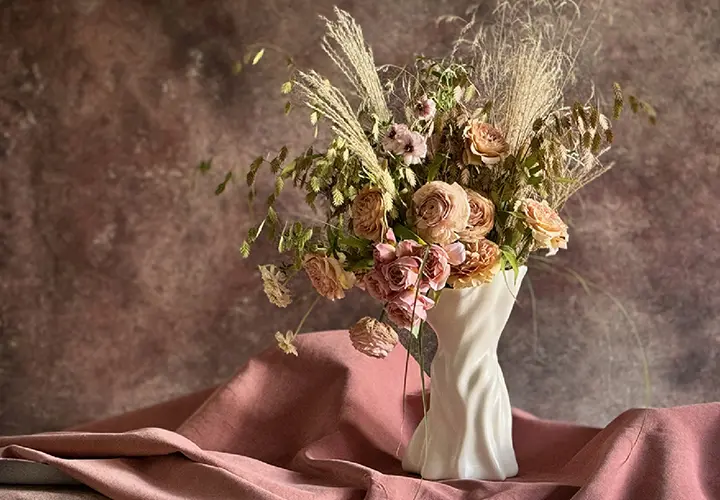
Fifteen years of arranging flowers for other people means you notice things most vase designers never do, because most people who design and make vases, especially for wholesale, don’t actually arrange flowers themselves. I see the stems inside the vase first: where they need to sit in the water to hold a visually pleasing composition above the rim. The folds and ridges that mimic fabric aren’t just decorative, they guide the stems into place, giving the arranger specific spots to tuck a rogue stem so it falls exactly where it should.
Your design process moves between hand-sculpting and digital tools. Could you take us from the first sketch or clay idea through 3D modeling, flower testing, mold-making, and the finished porcelain piece?
I sculpt in a variety of mediums, wax sculpture clay, sometimes a gloopy combo of fabric and Mod Podge then move to high-tech scans of those 3D sketches and sculpt digitally from there. I’m entirely self-taught in 3D modeling, but like most digital mediums, it allows for so much play and iteration.
Once I feel I’m heading in the right direction, I 3D print the piece in my home lab, which is built from printers. I also had to learn to build and service myself. I print in a plant-based filament that lets me make full-size, watertight vases I can actually put real flowers in. A lot of pieces don’t make it past that first print, they stay on shelves, in boxes, for me to come back to later.
Every piece in the collection came together differently. Some were instant- Draped No. 1 barely changed from wax clay to 3D print to final porcelain form. Others took years: my new Pedestal No. 1, a fresh take on centerpieces, took close to three years of iterations and studying other forms.
A piece is really ready when I can’t stop arranging in the 3D-printed version. At that point I make a scaled-up model, which goes to Oregon to have a pottery plaster mold made, that’s what lets us produce the porcelain pieces.
Your vases have the folds, curves, and sense of movement we normally associate with fabric. When you begin designing a new piece, what comes first: a particular flower, the gesture of an arrangement, or a visual reference from fashion or art?
It really varies. With Draped No. 1, it was the flower. My collection of rare tree peonies, which only bloom for five or six weeks. I wanted a vase that could hold a lot of their huge blooms but still let them fan out and shine individually.
Sometimes it’s a gesture like holding a handful of stems in your hand as you’re cutting from the garden, or picking up small bunches at a market stand. Most people are looking at the flowers above their grip; I’m looking at what those stems need to hold them exactly as they are in my hand.
And sometimes it’s a reference like an image that strikes me. That can spark an idea so vague I can’t connect it to a piece yet, or it can lead somewhere entirely new. Right now I have a few references I’m considering for candlesticks and votive holders, a product category I haven’t made before.

Twist No. 1 was influenced by archival and contemporary Dior and the way fabric is draped around the body. Can you walk us through how you translated that softness and movement into the form of a vase?
During the pandemic, when couturiers were working from home with old fabric, Maria Grazia Chiuri’s team posted a neon tulle drape, not a full design yet, just pinned to a dress form. I was struck by the color and the way the folds flowed diagonally across the body. My grandmother was a fashion stylist and buyer going back to the early ’60s, so I grew up with a broad knowledge of the greats of that era, and that neon dress reminded me of a piece from Mr. Dior’s own time, that same line was there.
I started sculpting that line into what would become Twist No. 1, widening the opening at the top like the neckline of a dress so flowers could spill out, and trying to capture some of that same movement in the “hem” of the piece.
I was so excited later to see JW Anderson referencing some of the same archival pieces in his early collections. There’s an embrace of femininity and curve in these houses that lends itself naturally to flowers, a lot of designers even refer to their flowers as “she.”
You have described your garden as a living floral arrangement, planted in evolving palettes with textures and colors designed to unfold across the seasons. Has growing your own flowers changed your definition of what makes an arrangement beautiful?
Growing my own flowers has only deepened my appreciation for them, and for the people around the world who grow them for all of us. My garden has taught me patience and given me more optimism than I ever thought I was capable of. I grew up a cynical little New Yorker. Picture a five-year-old in all black, holding court with the eighty-year-old regulars at the corner cafe.
But planting a tiny plug plant, a sad-looking bare-root peony, or sowing seeds too small to see is an exercise in hope. It’s a belief that you’ll be here to see those flowers bloom, here next year for the next round, here in ten years to watch the tree they’re attached to mature. It took me until I was forty to really understand that, and I’m grateful I finally did.

Why has Barely Cinched become one of the pieces you use most often yourself?
It was my first vase, so it’s incredibly special to me. In 2020, I was in a dark place, like a lot of people were. I’d spent a decade building my floral design studio into something that supported me and my small team. We were doing work we were proud of, with clients who trusted new ideas. Then it all went on hold, which to me felt like it had simply gone away, through something entirely outside my control. I blamed myself for not being prepared, for not somehow foreseeing a global pandemic.
I threw myself into the garden doing everything myself that I’d planned to hire out, growing my own plugs, moving tons of compost, exhausting myself daily just to sleep. By August, with 100-degree days, that wasn’t sustainable anymore. I needed an indoor project, and a video of someone throwing a planter on a wheel was the spark. Philadelphia has a wonderful nonprofit called The Clay Studio, and they’d just resumed small in-person classes. I signed up for the one technique I’d never tried in eight years of art classes, including two years of art college: slip casting and mold making.
The minute I made my first mold, which was a simple two-part mold of a lightbulb I was obsessed. You can achieve folds and wall thicknesses in slip casting that hand-building or throwing can’t touch. I took the class twice and, by the end, became an Associate Artist, meaning I could work on and fire my own pieces independently. I still hold that title; it’s still my play space.
I made the first Barely Cinched in my second class session. It was a hard piece to mold. I wasn’t 3D printing or sculpting in wax yet, so it was rough. But the vase itself was a joy to arrange in. I’d made it for the handfuls of flowers I’d walk around the garden cutting, and it just worked.
I used it, people loved it on Instagram, but I didn’t think about actually selling it until I gave one to a client, the mother of a bride in 2022. She found me again in 2023 and told me she used that vase every week, sometimes every few days. It never left her kitchen island. That was the spark for turning it into a collection. Without knowing someone had used and loved it for a full year, I don’t think I’d have had the nerve to invest the years it took to make the rest of the collection real.
How should someone choose between Twist No. 1, Barely Cinched, Envelope No. 1, Draped No. 1, and Baby Twist for a particular arrangement?
I actually answer this for clients all the time, I ask what flower they always want to display.
Peonies in spring, roses in summer, dahlias in autumn? Barely Cinched. SHOP IT HERE
A snip of daffodils, a few tulips, a couple of fall leaves? Baby Twist, to add color and life to a desk or bedside. SHOP IT HERE
Hamptons hydrangeas, tall beachy grasses, a branch of plum or peach blossom? Twist No. 1. SHOP IT HERE
Bits foraged from late winter or early spring, a few herb stems, a stem knocked down in the rain? Envelope No. 1. SHOP IT HERE
Draped No. 1 is different. It’s the piece you have to really want, especially at its price point. It’s less about a specific flower and more about wanting that particular form in your home. SHOP IT HERE

Which vase would you recommend for someone who loves loose, romantic arrangements but does not have professional floral experience?
Baby Twist is what all my customers would say. It’s a great way to try out small designs. It’s personal, low-stakes, and it lets people flex their creativity and find what they actually love in flowers and color. It’s also everyone’s favorite piece to gift someone who’d love having flowers around more often.
From there, most people build out their collection based on their favorite flowers or a spot in their home they want to fill. I designed the whole collection with something like a vase library in mind, no matter the season or the flowers, there’s a form that works. Pedestal No. 1 is the newest addition to that library: a true centerpiece form that’s actually easy to arrange in. Bowls are notoriously difficult to arrange in, and I’ve removed that challenge entirely. I can’t wait for people to experience it.
Is there one vase in the collection that most fully embodies your floral design philosophy, and what about it makes it feel so representative of your approach?
I wouldn’t put a piece in the collection that didn’t work well, but I think Twist No. 1 most fully embodies what I’m trying to achieve. A tall cylinder vase is always hard to arrange in the rigid, straight sides and long reach down to the water means flowers have nowhere to go but straight up, fighting the vessel the whole way. By changing those lines, adding folds and movement to the rim, and leaving room for stems to flare out at both the base and the top, it achieves an effortless, natural-looking arrangement. The flowers themselves are exactly the same. I’ve just made space for them to behave the way they would in nature.
What is your best advice for making grocery-store flowers look more romantic and elevated?
Take the bunch apart. Grocery bouquets are designed to look full in the sleeve, not good in a vase. Pull them out, cut every stem to different lengths, and remove anything you don’t love, this is your chance to curate the bunch to your own taste, not anyone else’s. Then add one thing from outside: a branch from your yard, an herb, a few leaves. That one foraged element is what makes it read as designed rather than bought.
What is your best trick for making an arrangement look beautiful from every angle?
First, where is this arrangement actually going, and from what angle will it be seen? If it’s going against a wall, you only need to worry about one side, don’t waste time perfecting a back no one will see. If it’s going somewhere it’ll be viewed from all sides, turn the vase constantly while you’re working, every few stems rather than waiting until the end. Most people build a front and discover the back later.