
When people talk about Blue Zones, the conversation often focuses on food. We hear about olive oil, legumes, vegetables, and Mediterranean diets. But according to chef and cookbook author Francesco Mattana, the secret to Sardinia’s remarkable longevity goes far beyond what’s on the plate.
Sardinia, the Italian island where Francesco was born and raised, is one of the world’s original Blue Zones, regions where people consistently live longer and healthier lives than average. Yet as Francesco explains in his debut cookbook, Eat Like a Sardinian, longevity isn’t built on strict rules, trendy ingredients, or the latest wellness obsession.
Instead, it’s rooted in simple daily habits that have been part of Sardinian life for generations.
Food Is Just One Piece of the Puzzle
When people talk about Blue Zones, the conversation often centers on food. We hear about olive oil, legumes, vegetables, and the Mediterranean diet. But according to chef and cookbook author Francesco Mattana, the secret to Sardinia’s remarkable longevity goes far beyond what’s on the plate.
“As well as our diet, it is our way of living, the beautiful weather and our strong community spirit that led to Sardinia being identified as one of the world’s first Blue Zones,” he says. “Sardinians don’t just live long lives, they continue to lead full and active lifestyles well into old age.”
That distinction matters. Longevity isn’t built around a single superfood or wellness trend. Instead, it’s the result of a lifestyle where food, movement, relationships, and community naturally work together.
They Eat With the Seasons and stay close to home
One of the biggest lessons from Sardinia is surprisingly simple: eat what’s available when nature intended it. “Seasonal and local produce is not a trend in Sardinia; it is a way of life,” Francesco explains. “We want to eat the freshest, tastiest and most nutritious food possible, and cooking and eating only what is in season and available to us is the only way to do this.”
That philosophy extends to another important Sardinian principle: chilometro zero, which means sourcing ingredients as close to home as possible. The less food travels, the fresher and more flavorful it is, while also supporting local producers and reducing environmental impact. Long before eating local became a wellness buzzword, it was simply how Sardinians lived.
They Don’t Rush Through Meals
Many of us treat meals as another task to complete before moving on to the next thing. Sardinians tend to view them differently.
“In Sardinia, there is a culture of patience,” Francesco says. “Instead of seeing cooking as something that takes up too much time, we relax and embrace the process as much as the eating itself.”
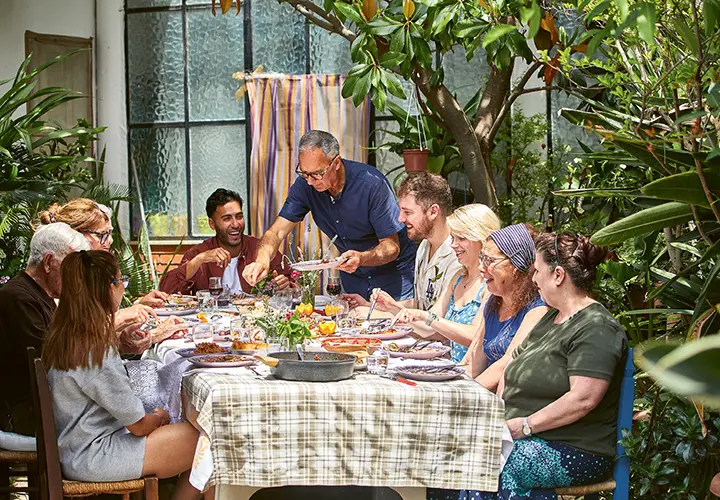
Meals are often enjoyed slowly, surrounded by family and friends. Conversation stretches beyond the final bite. There is no urgency to clear the table and move on.
It’s a reminder that eating is not only about nourishment. It’s also one of the ways we connect with the people around us.
They Prioritize Community
Research on Blue Zones often points to strong social connections as one of the biggest predictors of longevity, and Sardinia is no exception.
“Overall, it is all about community, natural movement, being outdoors, eating together, slow living and celebrating life,” Francesco says.
For many Sardinian families, meals remain a daily ritual rather than a rushed necessity. The dinner table is where stories are shared, relationships are strengthened, and multiple generations come together. It’s a tradition that may be just as important as anything being served.
Movement Is Part of Everyday Life
You won’t find many Sardinians obsessing over step counts or fitness trackers. Instead, movement is naturally woven into daily routines. “Natural exercise, like taking a passeggiata (walk) after lunch or dinner, is also common and part of everyday life,” Francesco says.
Rather than viewing exercise as something that only happens at the gym, physical activity becomes part of how people live, socialize, and spend time outdoors.
They Look Forward to Their Meals
Perhaps the most charming habit Francesco describes is the way Sardinians think about food. “At breakfast, we think about lunch, and at lunch we think about dinner, which means we are always looking forward to our next meal.”
It’s a philosophy that feels almost radical in a culture obsessed with restriction and food rules. In Sardinia, meals are not something to fear, rush through, or eat mindlessly at a desk. They’re moments of pleasure, connection, and anticipation.