
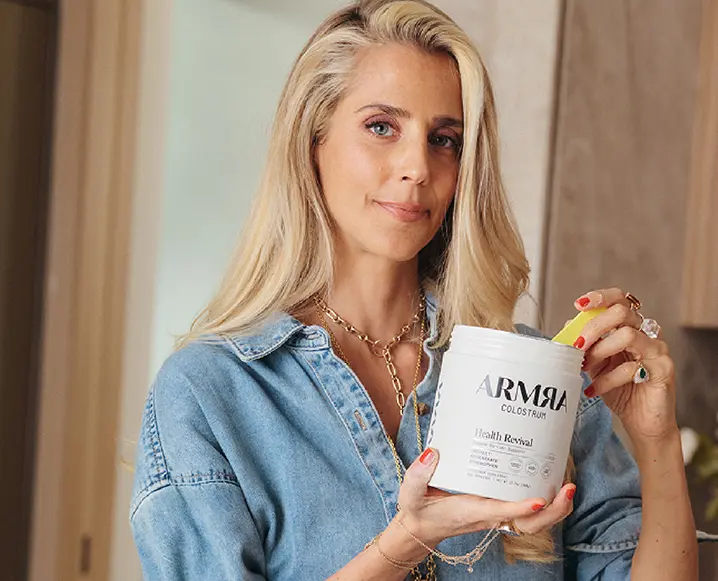
Dr. Sarah Rahal began her career inside traditional medicine, training as a double board-certified pediatric neurologist and working at the forefront of complex neurological care. But over time, her focus widened. Chronic illness was rising. Resilience felt harder to come by. And after facing her own prolonged health crisis, the questions became personal.
What actually sustains the body? What strengthens it before it breaks? That inquiry eventually led her beyond clinical practice and into building ARMRA. Still grounded in science, her perspective today is less about intervention and more about foundation.
In this conversation, she shares the thinking that shaped her transition, the rhythms she protects in her own life, and why she believes living well is often about restoring signal in a world that constantly adds noise.
Living Well with Dr. Sarah Rahal

You made a bold transition from double board-certified pediatric neurologist to wellness entrepreneur. What sparked that shift, and how has your clinical background shaped your approach to holistic health? It wasn’t ambition that pulled me out of medicine. It was a growing discomfort I could not rationalize away.
As a pediatric neurologist, I watched more and more children walk into my office with chronic issues that used to be rare. Digestive problems. Behavioral challenges. Autoimmune diagnoses. Constant fatigue. It stopped feeling like bad luck. It felt like a pattern.
I was trained in a model that views the body like a machine. Something breaks, you identify the part, you medicate or remove it. And in acute situations, that model is lifesaving. But when it came to chronic illness, it felt incomplete. We were managing breakdowns without asking why the system was so vulnerable in the first place.
Then my own body collapsed.
I was hospitalized for nearly a year and a half. I followed every protocol I had been taught to trust. I did everything by the book. And I kept unraveling. There is nothing like losing your own health to strip you of certainty. It forced me to admit that the framework I had been operating in was too small.
The body is not a machine made of isolated parts. It is a living network. A dynamic field of light, frequency, and magnetism, constantly responding to the signals around it. Every cell is listening. To food. To light. To stress. To sleep. To connection. To the environment. Health is not about swapping out broken pieces. It is about the quality of the signals the body receives and how coherently it can respond.
Once I saw that, everything shifted.
I stopped asking, “What drug matches this diagnosis?” and started asking, “What is disrupting the conversation inside this body?” What is weakening its resilience? What is interfering with its ability to adapt? That is what led me to colostrum. Not as a wellness trend, but as something foundational. It is the first nourishment we are designed to receive. It supports the gut, which is one of the primary interfaces between us and the outside world. It helps reinforce the body’s internal boundaries so it can respond intelligently rather than overreact or shut down.
My clinical background shapes everything I do. I am rigorous. I read the research. I question the data. But I no longer see the body as a collection of parts to be managed. I see it as an intelligent, responsive system that thrives when the right signals are restored.
I did not leave medicine to reject science. I left because I wanted a model of health that was big enough to hold the truth of how the body actually works.
ARMRA is rooted in science but designed for everyday people. Can you walk us through the research and philosophy that underpins your product formulations? ARMRA is grounded in science, but built for real life.
Colostrum is the first nourishment every mammal receives. It contains over 400 naturally occurring compounds, including immunoglobulins, lactoferrin, peptides, growth factors, and prebiotics that support the gut lining, tissue development, recovery, and overall resilience.
Controlled human trials in healthy adults and athletes suggest bovine colostrum may support gut barrier function, exercise recovery, and aspects of immune health. The research is promising and still evolving, as it should be.
My philosophy is preservation, not enhancement.
Most commercial dairy processing uses high heat, which can damage fragile bioactives. If colostrum’s power lies in its complexity, that complexity has to be protected. I spent two years developing our Cold-Chain BioPotent Technology to preserve colostrum at low temperatures and maintain its molecular integrity from start to finish.
We do not isolate or fortify. We preserve the full biological matrix as close to its natural state as possible. To me, science is about protecting what biology already perfected.
There’s a lot of noise in the wellness space. How do you ensure that ARMRA’s products are truly evidence-based and effective? First, we have a robust Science team with deep expertise, and we trust and lean on that guidance in everything we do. We build and communicate around the most up-to-date scientific research available, and we make decisions based on biology and evidence, not marketing trends.
Second, quality control is non-negotiable. ARMRA is produced in FDA-registered, GMP-certified facilities, and every batch undergoes rigorous third-party testing for heavy metals, glyphosate, and microbiological contaminants. Scientific integrity is not just about what you say. It is also about how you source, manufacture, and verify what you make.
Third, we welcome scientific curiosity and thoughtful skepticism. The research on colostrum and its bioactive compounds continues to evolve, and we are committed to communicating that science responsibly. When we reference the broader body of literature, we are speaking to established biological mechanisms and the growing research base, while remaining transparent about where the science is still developing. If you’re curious to explore ARMRA for yourself, you can shop it here.

What are a few simple, evidence-backed and doable daily habits that you believe make the biggest impact on long-term metabolic and hormonal health? The fundamentals still win.
Morning light. Get outside within 30 to 60 minutes of waking. Natural sunlight sets your internal clock and anchors your hormones for the day. It is one of the most powerful metabolic signals we have, and it is free.
Darkness at night. Real darkness. No overhead lights, no glowing screens in your face. Even low levels of artificial light can blunt melatonin and disrupt deep repair. Protect your nights as much as you optimize your days.
Preserve muscle. Resistance training is nonnegotiable if you care about metabolic and hormonal health. Muscle is metabolic currency. It drives insulin sensitivity, stability, and long-term resilience. It does not have to be extreme. It has to be consistent.
Calm your nervous system. Chronic stress, constant notifications, artificial light, nonstop input, it all adds up. Daily walks outside, quiet time, simple breathwork, even ten minutes without stimulation, restore regulation.
Health is rhythm. Light and dark. Stress and recovery. Effort and stillness. When your rhythms are intact, your biology follows.
How do you recommend incorporating ARMRA products into a daily wellness routine for someone who’s brand new to supplementation? I encourage simplification first. ARMRA is a whole food, not a synthetic supplement stack.
For most people, I recommend taking it first thing in the morning on an empty stomach. I personally dry-scoop four scoops of ARMRA Colostrum Unflavored. It is also a seamless addition to any cool beverage or food, like shakes, smoothies, yogurt, cottage cheese, iced coffee, or simply water.
Consistency matters more than complexity. ARMRA is designed to support foundational habits, not replace them.
How do you define impact in the wellness space? Impact is upstream. We are moving out of an era of maximalism: constant tracking, stacking, and optimization. If a brand helps people simplify and restore trust in their biology instead of micromanaging it, that is impact.
ARMRA was built not as another intervention, but as a reminder that the intelligence for resilience already exists within the body. To me, true impact changes how people relate to their health, from control to coherence.
What are you listening to lately? Any podcasts you’re loving right now? No. Right now I am not filling my head with more input. I spend so much of my life researching, building, thinking, creating. Silence feels more valuable than another voice in my ear. Sometimes the most productive thing you can do is turn down the noise long enough to hear yourself again.
Outside of ARMRA, what supplements do you personally take? Sunlight. It is the only true source of deficiency most of us share and the only one I am interested in supplementing.
We live indoors under artificial light, disconnected from the primary input that shaped human biology. Light regulates sleep, hormones, mood, metabolism. When that signal is missing, everything downstream feels it.
No supplement charcuterie board. No 38 pill launch sequence. My stack rises in the east. I look up.

Is there a nonnegotiable ritual in your day that keeps you grounded? Morning light is nonnegotiable. Before I do anything else, I step outside. A few quiet minutes in the sun, feet on the ground, breathing. It sounds simple because it is. That is the point.
I also protect stillness. Twice a day, I disconnect from noise and notifications. And at night, I sleep in total darkness. If you do not create quiet intentionally, your nervous system never recalibrates.
What advice would you give to physicians or researchers who are thinking about stepping into entrepreneurship? I can only speak from my own experience.
Entrepreneurship is not a choice you make. It takes hold of you. It is caring so deeply about bringing something into the world that staying where you are feels like a betrayal. It is not logical. It is not safe. It is an obsession you are willing to risk your comfort, your reputation, even your stability for.
You leave the structure, the credentials, the predictability. You step into something relentless and indifferent. There is no safety net. No one is coming to save you. You fall, and you trust you will find a way to climb back out.
You also have to be slightly delusional. You believe in a future that does not exist and hold it long enough for reality to bend toward it.
If you can walk away from it, walk away.
If you cannot, it has already chosen you.
Wellness means something a little different to everyone. How do you define “living well,” and how has that definition evolved throughout your career and life? Early in my career, I defined wellness as the absence of disease.
I was trained to believe that health was something you managed. Optimize it. Track it. Stay ahead of it.
Then life humbled me.
After my own health collapsed, everything shifted. Living well is not about control. It is waking up with energy. Sleeping deeply. Feeling clear in your body. Being present in your relationships. Handling stress without breaking.
It is not about doing more. It is about needing less.
Today, living well means returning to the basics our biology expects: light, movement, strength, real food, connection, purpose. When those are in place, the body works.
My career taught me how to treat disease. My life taught me how to live in health.