
Some of the links in this story are affiliate links, which means we may earn a commission if you choose to purchase—helping us continue to share mindful, inspiring content.
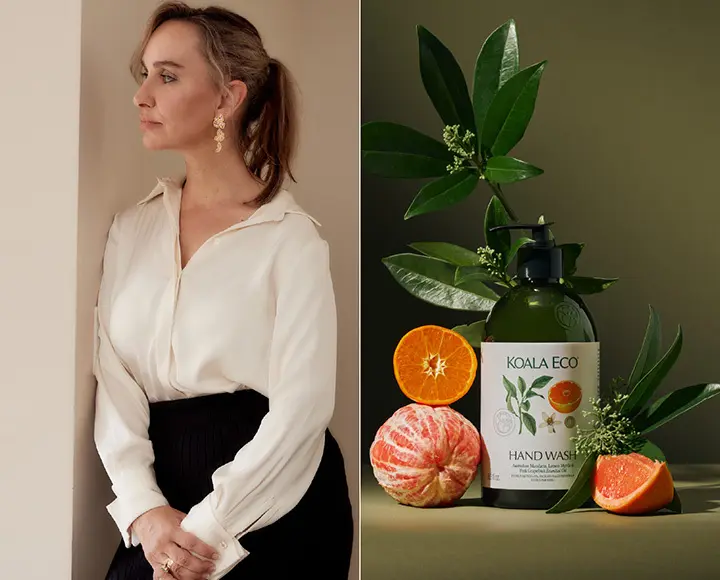
Long before “clean living” became mainstream, Jessica Bragdon was thinking deeply about the impact everyday household products have on our wellbeing. After her infant son survived neuroblastoma, Jessica and her husband, Paul Davidson, founded Koala Eco in 2017 with the goal of creating products that felt safe, effective, and genuinely beautiful to use.
Rooted in ecopsychology and a deep connection to nature, Koala Eco has grown into a brand that sits at the intersection of cleaning, wellness, and sensory living. In this edition of Living Well, Jessica opens up about building a purpose led business, the emotional power of scent, and why the products we use at home matter more than we think.
Living Well with Jessica Bragdon
We spend so much time trying to optimize wellness through supplements, skincare, and routines, yet people rarely think about cleaning products as part of that conversation. Why do you think that disconnect exists? I think wellness has become overcomplicated. There’s so much noise. Supplements, protocols, routines, whatever the algorithm is selling that week. The actual fundamentals get lost. The fundamentals haven’t changed. Time outside. Nourishing foods and exercise. Looking after your mental health. Not putting unnecessary chemicals into your home or onto your skin when you don’t need to. That’s most of it.
Cleaning hasn’t been part of the wellness conversation because cleaning was framed as a chore. The aisle was built that way. Bright warning labels, harsh smells we’ve been trained to read as “clean,” to think that the chemical smells you spray in your home are normal. Products you use quickly and forget about.
But the air at home is one of the most consistent inputs on your wellbeing, and conventional cleaning products release synthetic compounds that linger long after you’ve sprayed them. I think the conversation is starting to shift. People are looking at their cleaning cabinet and their home the same way they look at what they eat and put on their bodies.
You’ve spoken about ecopsychology and the idea that human wellbeing is deeply connected to nature. How does that philosophy directly influence the way products are formulated? Ecopsychology is the idea that we’re part of the earth, not separate from it, and that our wellbeing is bound up with the natural world. It sits underneath everything we do.
In practice, it shapes the formulations in two ways. The first is what we use. 100% pure essential oils from Australian native botanicals. Eucalyptus, lemon myrtle, peppermint, rosemary, rosalina, mandarin. They’re the essence of the plant, not perfume. Combined with plant based surfactants and sugar derived alcohols, they clean as well as conventional chemistry, and they carry the benefits of aromatherapy at the same time.
The second is what we leave out. Synthetic fragrance, undisclosed additives, anything we wouldn’t want our children breathing in.
There’s a Henry David Thoreau line: “we need the tonic of wildness;…. we can never have enough of nature.” I believe in it completely. Koala Eco is, in a way, the operational version of that idea.

What are a few easy swaps you genuinely think are worth making in the home? A few things I’d recommend.
Switch your most used cleaner, whatever you spray on the counter every day, for something plant based. The air at home is the most consistent input on your wellbeing, so that’s the first place I’d start.
Switch your laundry detergent. Conventional detergent leaves residue on every fabric your skin touches all day, and the difference when you change it is noticeable within a week. Most people tell us they didn’t realise how much synthetic fragrance they’d been wearing until it was gone.
And switch your hand soap. It sits next to the sink and gets used more than almost anything else in the house. A small swap, very repeated, very effective.
A lot of natural cleaning products either don’t work well or don’t feel elevated to use. How important was it for you to prove that efficacy, design, and sustainability could all coexist and how did you actually ensure Koala Eco delivered on all three? This was the central thing we set out to prove. The cleaning aisle had generations of consumers convinced that non toxic and high performance were a trade off, and we didn’t accept that.
Performance is the foundation. We work with an in house chemist who has more than forty years of experience formulating cleaning and personal care products, and we don’t release anything that doesn’t outperform its conventional counterpart. Every product on the shelf has been through that filter. The chemistry of plants, properly handled, is extraordinary. Combined with plant based surfactants and sugar derived alcohols, our formulations clean as well as conventional ones, often better, without putting unnecessary toxins onto the surfaces of your home.
The bottles are made to live on the counter rather than be hidden under the sink. Recycled, recyclable, refillable.
Sustainability is the operational core. We manufacture locally in Australia and the United States to support local economies and avoid the environmental cost of shipping products across the world. We’re a member of 1% for the Planet, partnered with Repurpose Global and the Oceanic Society. This is how the company was built and what we believe in.
What were some of the biggest challenges in building a purpose led business in a category dominated by huge legacy brands? The legacy brands have decades of shelf space, distributor relationships, and budgets we’ll never match.
What you have, as a smaller company, is authenticity, conviction, and speed. You can be specific about ingredients in a way they can’t. You can move quickly when consumer expectations shift. You can refuse a partnership that doesn’t fit your values. You can say no to compromising on ingredients to reduce costs.
The hardest part, and nobody really warned us about this, is the discipline of saying no to growth that looks good on paper but doesn’t square with the company you’re trying to build. We’ve turned down a lot of things. Funding that came with conditions we weren’t willing to accept around growth pace, control, or trade offs we don’t believe in. International partners who looked great on paper but were not the right partners. Each of those decisions costs money in the short term. None of them has been wrong in retrospect.

What truly sets a Koala Eco formula apart from both conventional cleaning products and other “green” brands on the market? A few things, and all of them take discipline.
The formulation is the obvious one. 100% pure essential oils from Australian native botanicals, plant based surfactants, sugar derived alcohols. We name every ingredient on every bottle. We don’t hide behind the word “fragrance,” or “natural fragrance,” which is a regulatory loophole many brands still use. People should know what they’re spraying around their homes and families.
Performance is the other piece. A lot of natural products underperform because they were formulated for a story rather than a job. Ours actually clean. Kitchen counters, glass, floors, laundry. We tested obsessively before launch, and we still test continuously.
But the deepest difference is the worldview underneath. Ecopsychology, the belief that connection with nature is foundational to wellbeing, informs the formulations, the scent identity, the operational decisions, and the people we hire. Cleaning, in this frame, becomes a small daily ritual. A reason to pause. A reminder that, when we return to nature, we return to ourselves.
I love that your team gets two paid hours a week simply to spend time in nature. What inspired that policy, and have you noticed a shift in creativity or wellbeing because of it? The policy comes directly out of the company’s worldview. If we believe time in nature regulates the nervous system and improves wellbeing, and we do, because the research is unambiguous, then we have to actually build that belief into how the business runs. Otherwise it’s just a tagline on a bottle.
Two hours a week is a small thing. A walk in the park. Time on the beach. Time outside, paying attention to something. The structure of a flower, the bees in the garden going about their business. People take the time, and they come back stronger.
What I wasn’t expecting was how much we’d talk about it as a team. People bring their experiences back into the room. What they noticed on a walk, a moment where they realised they’d been holding tension somewhere they didn’t know about, an idea that arrived because they’d stopped trying to think of one. We discuss it openly in our team meetings. It’s become a kind of shared vocabulary, which is its own form of culture building.
The other thing I didn’t expect was how it would change the way people understood the work itself. Nobody on the team thinks of time outside as a perk anymore. They think of it as part of the culture, which is what it is.

If someone was completely new to Koala Eco, which three products would you tell them to start with and why? I’d start with the Kitchen Multipurpose. It replaces three or four products under most sinks, and it’s the bottle you’ll reach for daily. Kitchen, dining room, anywhere with a hard surface. Bright, clean, quietly grounding.
Then the Dishwashing Liquid. Lemon myrtle and mandarin. Concentrated enough that the bottle lasts longer than people expect. All of our products are concentrated.
The third is the Laundry Liquid. It’s the one most people don’t realise will change everything until they make the swap. Conventional detergent leaves residue on every piece of fabric your skin touches all day. Sheets, T shirts, the towel you wrap around your kid after a bath. Switching changes how your clothes feel against your skin and how your home smells once the wash is done.
So: kitchen, dishes, laundry.
The scents in Koala Eco products feel almost like aromatherapy rituals disguised as household products. Was that dual purpose intentional and how much does Australian nature influence the scent identity of Koala Eco? Yes, completely intentional. Essential oils aren’t only beautiful to smell. They have real properties. Rosalina for relaxation. Mandarin as the “happy” oil. Peppermint to refresh. Eucalyptus to clear. When you open a bottle of Koala Eco, you’re literally breathing in the healing power of nature, which is something I never want to lose sight of.
Australian nature is the entire scent identity. Eucalyptus, lemon myrtle, rosalina. These are native plants with their own chemistry. The continent has a particular smell to it. Sharp, green, mineral, occasionally medicinal.
We don’t say “fragrance.” We use essential oils, named individually, sourced specifically. That precision matters.
What’s personally your favorite scent in the range? Lemon myrtle. It’s distinctly Australian, instantly recognisable, and it does something to the mood that’s hard to describe and impossible to fake. Bright and clean and quietly steadying all at the same time.
Mandarin is a close second. Joyful, generous. The “happy” oil for a reason. And peppermint. I love peppermint, especially first thing in the morning. It clears the mind and feels fresh.
Walk us through a typical cleaning day in your home. Which Koala Eco products are you reaching for from morning to night? The honest answer is that we’re busy working parents. Paul and I both run the company, two boys, a dog, cats, the usual. Cleaning happens around all of that, and a lot of it is rushed.
Mornings are mostly in the kitchen and out the door. Kitchen Multipurpose for a quick wipe of the counters. Dishwashing Liquid for whatever didn’t make it into the dishwasher overnight. Then everyone is off to work and school.
Through the day there are smaller rituals when there’s time for them. Glass Cleaner when the light catches the smudges on the windows. Bathroom Cleaner once or twice a week. Floor Cleaner, mandarin and peppermint, when the dog has tracked something through the house.
Evenings are quieter. Body Wash and Hand & Body Lotion. The Lotion in particular: pink grapefruit, mandarin, lemon myrtle. The Laundry Liquid, I love the Rosalina.
It isn’t a curated routine. It’s a household. But the products themselves make the rushed parts a bit more pleasant, and that, to me, is the point of using something you actually like.

What advice would you give someone who wants to build a business that’s both commercially successful and deeply values driven? The shortest answer is they’re not separate.
People still talk about purpose and profit as if they’re in tension. In our experience, they’re really the same conversation. A company that operates from clear values makes better long term decisions, partly because there are fewer of them to make. The values do half the work for you. You don’t agonise over a particular partnership. You already know.
A few practical things. Be honest about the financials. Purpose led doesn’t mean financially loose. The discipline of running a real business, cash flow, margin, inventory, and P&L is what allows you to keep doing the values led part.
Hire people who share the worldview. We’ve made important decisions on hiring, and having an incredible team of people around you is critical.
And be willing to walk away. Pivoting isn’t a problem. Pretending something is working when it isn’t, that’s the trouble.
Shop the Clean Living Ritual
If you’re going to start somewhere, make it the products you use every single day. The small swaps tend to be the ones that completely change how your home feels.
- The counter reset ritual: Koala Eco Multi Purpose Kitchen Cleaner for wiping down the kitchen at the end of the day. The lemon myrtle and mandarin scent makes the whole room feel fresher instantly. Shop here.
- The “your house smells good” move: Koala Eco Pink Grapefruit & Peppermint Essential Oil Room Spray. Crisp, fresh, uplifting, and the kind of scent people immediately ask about the second they walk through the door. Perfect before guests come over or anytime your space needs a quick mood shift. Shop here.
- The clean girl kitchen upgrade: Koala Eco Glass Cleaner for mirrors, windows, and shiny countertops that somehow make the whole home feel more elevated. Shop here.
- The easiest wellness swap: Koala Eco Bathroom Cleaner because harsh chemical bathroom smells are truly unnecessary. Shop here.
- The fresh sheets obsession: Koala Eco Laundry Liquid. Jessica mentions in the interview that most people don’t realize how much synthetic fragrance is lingering on fabrics until they switch. Shop here.
- The sink side essential: Koala Eco Hand & Body Wash for turning something as basic as washing your hands into a tiny aromatherapy moment throughout the day. Shop here.
- The little luxury detail: Koala Eco Dishwashing Liquid in Lemon Myrtle & Mandarin. Surprisingly chic for something you’ll use every day and honestly makes doing dishes feel slightly less painful. Shop here.
- The evening reset ritual: Koala Eco Multi Purpose Kitchen Cleaner paired with a reusable cloth, low lighting, and a playlist while doing a quick tidy before bed. Weirdly therapeutic. Shop here.
- The Sunday reset combo: Koala Eco Floor Cleaner with fresh flowers, windows open, music on, and a full apartment reset. The mandarin and peppermint scent makes the entire house feel fresh. Shop here.