
We talk a lot about gut health and skin health, but rarely about the health of our homes. Yet the products we use to clean our spaces affect everything from air quality to how our bodies feel day to day.
Many “non toxic” cleaners sound reassuring, but behind the labels are vague claims and formulas that either don’t work or rely on harsh chemistry. It often feels like choosing between a clean home and a healthy one.
Alter:Bio is reframing that idea entirely, treating the home as a living ecosystem rather than something to sterilize. We sat down with the founder to talk about healthwashing, antimicrobial resistance, and why your home’s microbiome deserves more attention than it gets.
The New Approach to Cleaning
Before starting Alter:Bio, what frustrated you most about the cleaning products available, especially the ones marketed as “non toxic”? For years, I relied on “non-toxic”, “green”and “inspired by nature” labels, assuming they were safe. I didn’t realize that “healthwashing” was rampant or that terms like “non-toxic” are mostly unregulated, vague, and difficult to prove. My wake-up call was physical—I developed rashes and eczema from exposure to harsh chemicals, heavy fragrances, and hidden plastics I didn’t even know I was consuming. Watching family members struggle with similar allergen flare-ups, especially one with terrible asthma, while using products marketed as “non-toxic”, confirmed better solutions needed to exist. “Natural” cleaners were often ineffective, while “effective” ones were toxic. Most “natural” cleaners are ineffective, and the “effective” ones are often toxic. In America, companies can get away with this trade-off. I realized that consumers were being forced to choose between their health and a clean home, and I refused to accept that we couldn’t have both.
You’ve described Alter:Bio as the future of clean. What gap did you see in the American market that nobody else was addressing? The gap was the intersection of true safety and clinical efficacy. Cleaning products have a core function: to clean. Yet, most effective products rely on harsh antimicrobials that contribute to the global crisis of antimicrobial resistance (AMR). On the flip side, my friends who were pregnant or managing asthma had limited or zero doctor-recommended options. I saw a massive need for a “science-first” solution that met strict health standards—inclusive of pregnancy and pet safety—without compromising on performance. No other brand in the US is offering the level of bio-intelligent efficacy that we are, and very few cleaning brands offer human-safe testing or toxicologist-approved pregnancy, child and pet safety.

Synbiotics are well known in gut health, but almost unheard of in home care. What made you believe this technology belonged in our cleaning routines? While living in Europe, I spent two years searching for a better way and found amazing biotech innovations coming out of Europe. I discovered a Belgium lab that had spent 20 years researching biologicals as a solution to antimicrobial resistance (AMR). Their research focused on using “good” bacteria to outcompete the “bad”—just like in our gut. Traditional cleaners that “kill 99.9% of germs” indiscriminately wipe out the good bacteria we need for a healthy immune system. By applying synbiotic science to our homes—our surfaces, air quality, and dust—we can clean deeper without the chemical health hazards, and keep the wellness of our home intact.
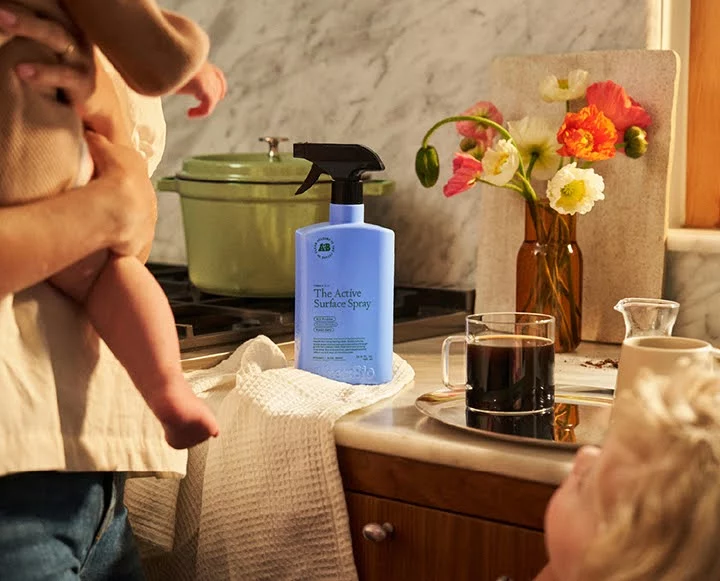
Can you explain how probiotics and prebiotics work together once they land on a surface? What are people not seeing that’s actually happening? The technology is quite fascinating, in a biomimicry way. In the bottle, our probiotics are in a dormant “spore” state, which keeps them stable. The moment you spray them onto a surface, they detect food (dirt, grime, and bad bacteria) and moisture. This “wakes” them up, triggering germination. They become active, vegetative cells that release enzymes to break down dirt and biofilm. Unlike traditional sprays that stop working the second they dry, our synbiotics continue cleaning your surfaces for up to six days after a single spritz. It’s the difference between sterilizing a space and creating a healthy, self-regulating ecosystem.
In your research, what did you learn about how home environments impact our immune system, air quality, or even daily stress? The majority of our time is spent in our home, that is why I wanted to make sure that Alter:Bio was built using the best quality ingredients, many of which are skincare grade level, that we could find – from our synbiotics, to innovative surfactants, and clean scents – to deliver on said performance and safety standards.
Through my research, it was quite disturbing to learn of even neurological effects that have been proven to be impacted by harsh chemicals, found in everyday cleaning products. I met with a prominent Neurologist, Dr. Tesar, of Tesar Labs, Research at Case Western, to better learn about his studies and approach. He explained to me that common household chemicals—specifically quaternary ammonium compounds, which are found in so many cleaning products—can damage brain cells tied to our nerve system. This damage is linked to neurological diseases like Multiple Sclerosis. That’s why I worked tirelessly to find a 100% biodegradable Quat-alternative that delivers the clean without the neurotoxic risk.
I was lucky to meet Dr. Charlotte Goldfine, of Yale School of Medicine, previously Brigham Women’s Health, who is now Alter:Bio’s internal Medical Advisor. After reviewing our multiple lengthy toxicologist reports and dermatological-tested results, she shared, “This synbiotic cleaning technology utilizes a well-studied combination of probiotic strains and targeted prebiotics to establish a beneficial and resilient surface microbiome. With many years of safe use in hospitals and healthcare settings, and supported by multiple clinical studies, these synbiotics have been validated to perform on par with traditional chemical detergents, while offering significant advantages in terms of safety and sustainability. The probiotics used are non-pathogenic and safe for children and animals, making the product suitable for environments for all populations. Its extended efficacy, lasting several days after application, represents an innovative way to clean that aligns science, health, and safety”.

Alter:Bio was researched and designed in Europe to meet stricter standards. What standards mattered most to you and why? Living in Europe, I saw how much my own skin and health improved, largely due to their “Precautionary Principle.” The EU bans ingredients if there is even a potential risk of harm. The US, conversely, often allows ingredients until harm is effectively proven after millions of cases. I wanted to bring that stricter European safety standard to the American market. I felt abiding by all of the EU’s regulations was what Alter:Bio had to do, thus all our formulations are based on these stringent standards, ensuring our products are safe for the most vulnerable among us.
What do synbiotics allow you to do that traditional or even plant based cleaners simply cannot achieve? The “hero” difference is time, resulting in cleaning performance. Traditional cleaners stop working the moment they evaporate. Because our formula contains living synbiotics, they continue to release enzymes and “eat” bad bacteria for up to six days – on a microscopic level. Most ‘non-toxic’ marketed products haven’t gone through stringent testing (i.e. ‘human-safe’ or dermatologist-tested), nor offer biotech science in their solutions. You simply cannot get that continuous, microscopic cleaning power from a standard chemical or basic plant-based spray. This is where Alter:Bio stands out among simple healthy formulations. Performance is just as important to us as health.
What personal values shaped Alter:Bio’s formulation process? Was there a non-negotiable that guided every decision? I believe in purposeful business; we have to be aware of the human and environmental cost of what we create. This holistic view comes from my life outside the office—from managing my family’s regenerative farm in Oklahoma, to my work as a Council Leader with UNICEF NextGen, and investing in women’s health and healthtech. My work needs to be tied to building a healthier world. This bridges into every detail – for example, with our formulas, all ingredients had to be 100% readily biodegradable, as they affect our water streams. With our custom packaging, we chose recycled HDPE plastic over glass because UV light deactivates the synbiotics, and surprisingly, recycled glass can often have a higher carbon footprint and microplastic yield. I work with a 3PL that focuses on circular economies. Every decision is about building a healthier smarter ecosystem, and we are constantly evolving to offer the best that we can for our customers, through a climate and safety lens.
What categories or innovations do you imagine coming next for Alter:Bio? We are just getting started! Our mission is to provide products that meet our standards and vision of ‘redefining clean’ through microbiome health, and honestly are also exciting to use. Design is extremely important in everything built at Alter:Bio, from the formulas to the custom bottles created to be ergonomic and fit around small sinks, to colors and detailed branding. I am so excited about all of our new developments in the cleaning essentials category and wider ‘clean’ category that we are working on now. There are also packaging updates, more sustainable changes and the opportunity to extend our brand vision. We are building a future where our cleaning products actively contribute to a healthier home and planet, and I can’t imagine operating any other way.